The Impression We Leave Behind

In recent weeks, two different musicians headlined stadium tours each promising three consecutive concerts held within a few hours of Weakley County.

The first tour took place in Oxford, MS featuring country star Morgan Wallen. The weekend ended on a sour note when Wallen failed to appear for the final concert. Despite an explanation offered by concert officials, fans who spent hundreds of dollars on tickets and travel expenses were disappointed by what they perceived as mismanagement by the artist and his team.

Two weeks later, pop sensation Taylor Swift performed in Nashville. The weekend ended on a high note after fans took shelter for hours during a thunderstorm delay, only to have Swift reemerge and perform her entire 3 ½ hour show in a driving rain for the 70,000 fans gathered at Nissan Stadium. Many concert goers remarked that the experience became even more memorable as the crowd joined together to sing the whole show despite the terrible weather conditions.

While these incidents concern fans and celebrity entertainers, we also leave an impression in each of life’s interactions.

We are not paid performers, but we are called to be intentional about the impact we leave with the people we encounter each day.

In the Sermon on the Mount (Mt 5-7), Jesus employs multiple images to talk about using our influence to draw others toward God.

In referencing light, Jesus declares that His followers are “the light of the world” (Mt 5:14).

We understand the attractive qualities of light. Physically and psychologically, we feel safer and more secure in a well-lit place. If we look into darkness, our eyes are immediately drawn to the points of light. A light in darkness even instinctually impacts insects and animals- whether a porch light or a full moon.

As believers, we are to point to God as the true light in Whom there is no darkness at all (1 John 1:5). We let our little lights shine to direct and draw people to Him as the source of light and life. Just as physical light is essential for our flourishing and thriving, sharing spiritual light is vital to faithfully following Jesus.

Jesus also paralleled the influence of a believer with being “the salt of the earth” (Mt 5:13).

Salt is a fascinating element in our world- needed in life, preserving in death, and impacting the flavor and nature of everything it touches. As any cook will tell you, even just “a pinch of salt” has a big impact on a dish. Salt is abundant, and yet precious. Until modern refrigeration, salting/curing was a primary method of preserving food. Through history, salt served as valuable currency and a staple of provisions.

It takes no culinary expertise to notice the absence of salt in a favorite meal, or conversely, the overuse of salt in our food. While salt is often a foundational ingredient, just a little bit makes a big difference.

The correlation of a Christ-like influence is apparent- even a small amount of love, grace, and compassion impacts the whole flavor of the lives it touches.

When we engage with others, do they feel warmed by the light and love of Christ or do they feel cold rejection at our indifference?

Do people taste the goodness of the Lord (Ps 34:8) in our words and actions, or do they leave our presence with a lingering bitter aftertaste from our scorn or judgment?

As has often been said, “People may forget what you said, but they will never forget how you made them feel.”  

We want the impression we leave to draw others closer to Christ.

Through our daily actions and attitudes, may we always strive to leave each person we encounter with a faithful impression of the Lord we claim to serve.


Making Our Mark

We live in a culture full of symbols- road signs, yard flags, car decals, corporate logos, and electronic billboards. These symbols do not tell the whole story, but they serve to market products, draw our attention, or declare our loyalties to the passing world.

We understand that such markings have meaning, and while we do not always agree on the interpretation of a certain symbol, we recognize that these visible marks serve as powerful reminders and signals to those who we encounter each day.

In this graduation season, one oft-repeated piece of advice for those receiving degrees is to go out from the classroom to make a difference in the world. “Leave your mark” is considered a fitting encouragement as we enter a new phase of life.

All of us long for significance, and we long to believe we offer something of value to the world. Teachers, salespeople, ministers, parents, celebrities- everyone wants to make a mark that will matter and endure in our rapidly changing world. Our motivations (such as profit/prestige/power/compassion) may differ widely, but the desire to make an impact is a reality.

As believers, we are leaving an impression of the world each day. Words matter- the symbols we embrace and words we offer impact our family, friends, neighbors, and even strangers for good or ill.

It is wise then to appreciate the truth that the words and actions that mark our lives affect the impressions we leave on others.

In Scripture, we read about the marking of people by the use of descriptions or nicknames. In Acts 4, we meet Barnabas whose actual name was Joseph- an extremely common name. Barnabas (meaning “son of encouragement”) was the nickname he received because he was always using his wealth, words, and relationships to build others up.

Brothers James and John were called Boaneges (meaning “sons of thunder”) seemingly related to their intense (though at times misguided) passion for God’s justice (Mk 3:17; Lk 9:54).

Besides Simon Peter (Peter itself serves as a symbolic nickname- Mt 16:17-18), Jesus called another Simon to his inner circle, “Simon called the Zealot” (Lk 6:15). This Simon was known for a life marked by his nationalism (at least in his background before following Jesus).

Is my life more marked by sharing encouragement, living with passion, or debating my politics? I am I marked as one who looks to see the good in those around me or as a person who would call down fire on my opponents if given the opportunity?

Paul writes to the church at Rome about the importance of recognizing and marking those who only seek to cause division (Rom 16:17). Their divisive activities were known and reputations well-deserved. Faithful Christians were to avoid being drawn into endless debates with such people- mark them as troublemakers and unless genuine change occurs, avoid becoming entangled in constant strife with them.

Many of us don’t mind marking those we dislike or disagree with, but Paul reminds the Philippian Christians to also mark those who walk as faithful examples to follow (Phil 3:17). If a person is walking the journey of faith well, we are to note and imitate the godly aspects of such a life (1 Cor 11:1).

Day by day, we are each making our mark on the world- what will your mark be?

As believers, may we be more intentional in realizing that no matter what else we may be, our primary role is to offer a faithful example of a life truly marked by the presence of Jesus.

Blessings of Life Together

“The person who loves their dream of community will destroy community, but the person who loves those around them will create community.”

Dietrich Bonhoeffer, Life Together

Being called to live in community is one of the great invitations of the Christian faith, yet living in community also produces some of the most challenging aspects of the Christian life.

Whether we like it or not, life in community is not an add-on feature to our already-complete, neatly-packaged personal holiness- the gospel does not call us to a life of spiritual individualism and social isolation, but to a communal pilgrimage through our collective brokenness and the messiness of shared experience.

Christianity is not a solitary religion- we are called to walk this life of faith together.

I believe one of the blessings of this community relationship we are called to share is that believers are entrusted with a common vocabulary. Words that seem idealistic or even corny in the “real world” hold deep and abiding significance for those seeking to faithfully follow Jesus.

Joy, mercy, sacrifice, and commitment can be experienced by all people, but the believer recognizes God as the source of these and seemingly countless other virtues.

Broader society may acknowledge grace, compassion, and love, but the disciple of Jesus knows more than the intellectual definition of these words- he or she knows the One who personifies of these concepts as the divine Source of everything good, right, and true.

In addition to giving us an experienced terminology for understanding of the virtues found in God, the Christian community provides us with a unique bond of fellowship.

Wherever Christians go in the world, they already have a spiritual family awaiting them.

Anywhere we find disciples of Jesus, we have the ability to share an immediate intimacy that serves as a comfort and blessing. Whether we come together on the mission field, in the chapel of the local funeral home, at our children’s summer camp, or in a passing incident of daily life, Christians have a bond that is able- when faithfully applied- to transcend the outward divisions of race, gender, economics, politics, or age. The ability to pray for each other, to comfort each other, and to worship together greatly shapes the Christian experience.

We are to be the gathering of the redeemed- existing across and above life’s many external barriers.

As the song states, we share, “a common love for each other, a common gift to the Savior, a common bond holding us to the Lord, a common strength when we’re weary, a common hope for tomorrow, a common joy in the truth of God’s word.”

As we consider the implications of the Christian experience, one of the foremost blessings that we share is a sense of a mutual destiny.

In a world where we are often lulled into the comfortable complacency of daily life, we are to remind each other that our ultimate reality and ultimate hope of victory are not tied exclusively to the here and now.

While neither ignoring nor excusing the ever-present need for greater compassion and justice in our troubled world, believers are called to look beyond today’s headlines to the glory that awaits us as children of God.

By looking toward our grace-fueled, glorified future, we are empowered to live faithfully as we seek to share Christ’s love today.

This certainty of the future should dictate how we live day by day- not with our heads in the clouds ignoring suffering and strife, but with our hands active in service seeking to share the glory we have already tasted in Jesus.

Our life together as disciples of Jesus is marked with manifold blessings- a common vocabulary, a shared fellowship, and a united hope of salvation that spans geography, time, and outward differences.

Through His grace, our Father offers these gifts to each of us if we have hearts willing to receive them.

People of the Second Chance

I finished an intense memoir by a woman who has struggled with many of the same mental health issues I have faced over the last two decades. One key difference in our stories is that, while she faced rejection from her family, bullying by so-called friends, and came to suffer from eating disorders, self-injury, and drug abuse, I received a stream of constant support.

Even though our medical charts might show a similar chemical starting point, our stories ultimately followed two extremely different paths. I know the intensity of my own pain even with so many advantages, and her candid story reminded me that each person we encounter is struggling with something- and often hiding it quite well for a long, painful time.

Every day we witness people making bad choices or falling into destructive patterns, and we are tempted to say, “They should know better.”

While taking personal responsibility for our actions is essential, we also need to appreciate the circumstances and conditions that have led others to where they find themselves. While accountability is vital, it is naïve to think that we all are starting our lives in the same place with all of the same advantages.

I realize all too well that it is a challenge to continue to offer grace to people who repeatedly make negative choices and break our trust, but I am so thankful for the many people in my own history who chose to give me those second and third chances. I am also grateful that I believe in a God whose active, life-giving grace provides me the ability to start over when I fall short.

While thankful for the day-to-day stability in this season of my life, I hope I never become so settled or so stable or so secure that I forget what it was like to need another chance. People were willing to give them to me when I didn’t deserve them, and I know that I too need to be an agent committed to sharing that same grace.

Each day we all encounter someone we can influence or encourage- someone who stands in need of another chance.

A kind word, a caring hug, or a thoughtful compliment can be such a catalyst in a person’s life. I pray we can all look to be that influence– the provider of the second chance.

Send that text. Mail that card. Make that call.

Understanding just what the person is facing is not possible nor is it really the point– we must simply realize that we don’t have to withhold our love from people until they get it all figured out.

In fact, we come to appreciate that it is in the act of loving people and extending another chance that they often realize the courage to hang on for another day and to begin moving forward.

  • I don’t have to fully understand to love you without condition.
  • I don’t have to fully understand to serve you without selfish motives.
  • I don’t have to fully understand to pray for better days to come.
  • I don’t have to fully understand to make sure you get home safely.
  • I don’t have to fully understand to sit up with you while you cry.
  • I don’t have to fully understand to realize we are all in this together.
  • I don’t have to fully understand to be willing to offer you a second chance.

Life is hard enough as it is, but it proves to be so much harder without support.

No one needs to face this life alone- especially when we each have the ability to make a difference.

May our eyes, ears, and hearts be open to opportunities; not to fix others, but to walk beside the hurting people in our lives and to extend to them the grace others have willingly given us. In seeking to lead with grace, we embrace the renewed life we have in Christ and are strengthened to share it with others.

Our Good Father

Recently an older man recounted to me his experience of leaving a small town in West Tennessee in the early 1950s to seek an athletic scholarship at a junior college in the Mississippi Delta.

After a couple of weeks of intense two-a-day practices in the swampy July heat of a Mississippi summer, the young man decided he had seen enough. Without any money, he called his parents late one evening to tell them he would come home and go to work instead of attending college. He would leave the next morning- hitchhiking back to Tennessee, and they could expect him home in a couple of days. He told the coach and his prospective teammates of his plan before lying down for the night.

After a few hours of fitful sleep, he felt himself being roused from his bunk for what he assumed was the normal 5 AM practice.

“I told y’all, I made up my mind. I am not going to stay here. I am going to go home in the morning.”

This man’s eyes glisten even seven decades later as he recounts the moment:

The thing was it wasn’t the coach at all. It was Daddy. He said, “Come on now, son, and get up, we’ve come to take you home.He never said nothing about it one way or the other, but he must have gotten together the gas money, left right after I called, and drove all that way through the night to get me. He never made me sorry I went or that I didn’t stay. He actually never said anything about it again- he just came and got me and brought me home.


So often in life, we take on more than we can handle- sometimes things that are wrong in themselves, but perhaps just as often, we tackle right things at the wrong time. When we reach our breaking point, we often think all that awaits us is a lecture, a criticism, or an “I told you so.”

The people around us certainly do respond that way at times. It seems so easy to see the errors and missteps in others’ lives- even as it often is so difficult to recognize them in our own.

But our God is different.

He is a Good Father that extends grace to us when we cannot see the clear way home. We are the ones who prepare speeches, practice talking points, and seek to bargain our way back into favor- He is the one who runs to us and lavishly extends welcome and grace (Lk 15).

Like our Father, Jesus, our beloved elder Brother, doesn’t make us try to figure out how to hitchhike up to Him to heaven, but instead humbly comes to us and extends compassion and models a new, better way of living (Phil 2:5-11).

The Spirit and the Scriptures are living and active forces in our lives- lifting our words higher in prayer (Rom 8:26) and guiding our steps day by day as we journey through this life (Ps 119:105).

That homesick teenager graciously brought back home almost 70 years ago, married the sweet beauty queen from the rival high school, built a local business through honesty and hard work, raised two children, and eventually became my grandfather.

He never earned that college degree, but his four grandkids each did, and we went on to have multiple advanced degrees between us- in education, business, pharmacy, and ministry.

He taught us all more life lessons by his example than he ever could have with any amount of higher education- quizzing us on our multiplication prowess at the dinner table, refusing to let us win at a game of H-O-R-S-E, serving with integrity in public office in a small town for decades, and loving each of us just as we were in all the highs and lows of life.

I give thanks that my great-grandfather who I don’t remember drove through the night down to the Delta and to bring home a homesick boy who would grow into a man I will never forget. Because he showed up with love rather than a lecture, that single act of grace lives on, and an entire family exists and our individual stories are unfolding as lives that are committed to growing in grace.

Grace is like that- unearned, undeserved, and most often, unexpected.

In life, sometimes we all need some correction, but we always need more grace.

Grace begets grace, and when we offer grace to one other, we are growing to be more and more like our faithful Father.

No act of grace, however small it seems, is ever wasted in the Father’s will.


Last night, shedding his earthly tent battered by years of toil and broken by recent sickness, my grandfather took his final breath here, and passed into the presence of the great cloud of witnesses and embrace of our Good Father. Like a boat slipping into the water in the pre-dawn stillness of his beloved Kentucky Lake, he left us here and went on to his reward.

We grieve today, but by the grace of the same Good Father, we know some day we will be united in a better land where every sickness ceases, death divides no more, and all who are weary are at rest.

We are thankful that, while we sorrow now, it is a sorrow drenched in the promises of our Good Father and in the hope of better things to come (1 Thes 4:13-18).

Let Us Not Grow Weary…

Does it seem like darkness rises up constantly in our world?

The challenges we face in our community, country, and world are not new, but our awareness of them seems to grow day by day. While this increase in information should cause us to advocate strongly for justice, it often leaves us feeling overwhelmed and disoriented. With the saints of ages past, we cry out, “How long, O Lord?”

As followers of Jesus, we are to be concerned about the injustices in our world. Racism, violence, oppression, and the fact that so many people are underfed, underhoused, and underloved in the midst of our material abundance should sound an alarm to every believer. Instead, perhaps as a means of self-preservation, we tend to ignore, downplay, and minimize these challenges as much as possible by suggesting God’s work is primarily future-focused.

“This world has a sin problem” or “We’ll understand it all by and by” are true enough at one level, but we dare not allow such phrases become shameful excuses for overlooking the kingdom work to which we are summoned. If Jesus is truly the same yesterday, today, and forever (Heb 13:8), then He came not only to heal, to save, and to liberate 2,000 years ago, but is seeking to do the same today through His people.

God has always been concerned about the troubles that trouble us.

Whether clothing Adam and Eve to cover their post-sin shame or touching the wounded and broken through the ministry of Jesus, our Father has always cared about His children who face the struggles and strains of daily life in our fallen world.

So much is wrong in our world that we can often feel overwhelmed by the sheer magnitude of obstacles we face. If we are not careful, we become cynical and frustrated by our seeming inability to make any difference. To our fellow believers who were struggling with the big picture and were tempted to give up, Paul wrote, “And let us not grow weary while doing good, for in due season we shall reap if we do not lose heart.” (Gal 6:9)

As we live daily in community, Jesus commands us to see with His eyes.

The challenges we face in our world are not merely abstract projects or impersonal budget line items- each issue involves real people with real souls who need a real and lasting connection to their Creator.

The grieving mother, the lonely widower, the hopeless addict, and the self-righteous preacher- all stand in need of the healing found through Jesus. Jesus sets a powerful example for us in how He was able to see and to serve real, struggling people in meaningful ways.

Not content to sit back debating theories with the religious, Jesus went to work healing, feeding, and comforting those who suffered most.

We are called to do the same.

This road to healing and restoration in our world will not be an easy one. Just as there is no shortcut to our own spiritual maturity, there is no fast pass to healing the pain of our world, yet we cannot allow the cynicism around us to drown out the certainty that our actions matter.

We cannot predict the harvest, but we can faithfully scatter seeds of hope.

Others will enter into our labors- just as we have entered into the works that began long before us. At times, weariness will rise, but by faith, we refuse to lose heart.

What we plant today in faithful tears will one day yield a harvest of blessing for those who follow us.

Making It Look Effortless?

Recently I heard an older woman praising a young mom’s ability to manage multiple family, work, and social responsibilities with the exclamation, “You just make it all look so effortless!”

We understand what she actually meant: “You are so talented and skilled at difficult things that it seems like you don’t even have to try very hard. You’re great!”

We know this compliment is intended as praise- the young mother appeared so skilled at managing multiple challenges that her busy life appeared to others to naturally flow with ease and grace. In reality, the busy mom was no doubt getting up early, dealing with stress related to her children and job, facing the daily struggles of life, relationships, and faith even as she “made it look easy.”

Appearances and reality are often not completely congruent- what others see may not be the entire truth of what we are experiencing as we live out our lives. Some folks around us seem to have it all together, but may actually be falling apart. Others are facing extreme outward challenges with their health, finances, or relationships, but may, in reality, have a deep sense of peace abiding within.

In a passing moment, our perceptions of others are often inaccurate and incomplete.

When we think of Moses, we think of a strong, fearless leader standing before Pharaoh demanding freedom for God’s people, but Scripture goes out of the way to show he was reluctant to accept his call to leadership and consented only once his more eloquent brother Aaron was allowed to be his spokesman. Elijah, who projected prophetic strength in public, was often despondent and discouraged before God. Paul confessed that his many persecutions and concerns for the churches he had planted were sources of anxiety for him and would have overwhelmed him had Christ Himself strengthened and sustained his ministry.

No one is quite as “together” as they seem to the watching world.

In Scripture, women often shine as examples of understated strength. In a culture where they were often in the background, women rise up and are held out to us as heroes of faith.

Rahab, a foreigner with a questionable line of work, becomes the lifeline for God’s people as one who acted in faith and whose name is eventually found in the genealogy of Jesus. Ruth, also an outsider, demonstrates the ability to care for an aged mother-in-law, to be the breadwinner of her household, and to secure a future for herself and her family with her godly character. Esther stands up to law, custom, and the whims of a fickle husband to intercede for her people in their darkest hour. Women are present throughout the ministry of Jesus and the remainder of the New Testament- hosting, financing, worshiping, teaching, and connecting the congregations of the early church.

A faithful life is never effortless for anyone regardless of what appears on the surface. The life of faith is an active one as we seek to grow in grace and serve others, but such commitment is worth our energy and effort as we seek to live for Christ.

May we look for faithfulness in unexpected places this week, and praise it when we find it.

May our own focus be more on building our inner character over maintaining our outward comfort.

When we willingly press further into God’s service by making an effort to use the gifts He provides, He gladly gives us the strength to joyfully live by faith.

Tend Your Garden

It may seem a bit early in the year to mention a garden, but those who plant and cultivate the soil to bring forth new life know that there is work and planning to do in every season. When it comes to tending the thoughts and feelings that we allow to take root in our minds and hearts, the cycle of planting, nurturing, and harvesting is ongoing- whether we consciously realize it or not.

I have been blessed to live my entire life in a series of rural communities that depend heavily on agriculture. My neighbors and I know what it is like to form a line of traffic behind tractors and planters throughout the work of springtime and then combines and cotton pickers during harvest of the fall. Even in our modern, fast-paced world, the rhythms of our lives are tied to the seasonal changes that impact the land and the folks who work it faithfully. Whether we ourselves are directly employed in agriculture or not, all of us should come to see that our food, clothing, and fuel are all connected to it- not only by local farms, but by the economic and environmental forces tied to farming around the world.

Simply stated, what we plant and harvest affects us all.

This reality is evident in physical farming, but it is just as true when it comes to spiritual matters.

In Hebrews 12, the writer says that encouraging one another is a vital part of the Christian experience. We are to pursue unity and peace, so we can live into the grace of God and receive the fullness of His promised blessings. We are to seek holiness and wholeness as God’s people- both individually and collectively. Why are we told to do these things? We are to actively seek to live together in grace and peace, “…lest any root of bitterness springing up cause trouble…” (Heb 12:15).

When I fail to tend the inner garden of my heart, and instead dwell on the shortcomings of others or the mistakes of my past, the root of bitterness begins to form in my thoughts, words, and actions. If unchecked, this poisonous plant continues to spread, grow, and strengthen within me.

You may have witnessed a once-cultivated field that has been left fallow and untended for a time. Almost overnight, weeds and grass will appear, then brush and saplings, and soon larger trees and invasive plants like kudzu and spreading vines will overtake the entire area. Despite decades of care, it takes a comparatively short time for that natural wildness to return and dominate once more.

Our hearts are no different.

Unless I am willing to daily examine my life and remove the dangers seeking to grow there, my faith will soon be overtaken by a growing tangle of negativity, bitterness, and self-focus. As these spiritual weeds grow up unchecked, they become so thick and abounding that it becomes far more difficult to remove them without causing severe damage to the fruitful aspects of my life (Mt 13:24-30). Sometimes we cannot see how much our own lives have been overtaken, and we need the caring counsel and encouragement of faithful friends to restore us (Gal 6:1-5). In the same way our local farmers rally to help when a neighbor is struggling to finish the harvest due to sickness or bad weather, we all need fellow believers to gather around us to support and lend a hand in when we face hard times spiritually (Rom 12:15).

Just as it is far easier to uproot a tender tomato plant than a century-old oak, we must recognize that removing negative attitudes and actions is much more easily done before they can take a firm hold in our lives.

“Old habits die hard” is a proven proverb, and so it benefits us and the people we love to deal with our sins and shortcomings before the roots deepen.

If we tend our garden faithfully, our opportunities for fruitfulness in God’s kingdom will grow, and our lives will have the spiritual space to flourish and impact others for God’s glory.

God of all questions…

Perhaps you have heard well-meaning folks facing difficult circumstances say, “Well, it’s just God’s will, and we can’t question it.”

We may have at times even expressed this idea ourselves. This statement usually arises from a mindset that trusting God without irreverently seeking to understand the deep mysteries of His ways is the marker of a genuine faith.

While this logic often springs from a sincere heart, is this the way we are intended to understand faith? Does biblical faith require us to suspend our questions?

If faithful people are never supposed to ask questions, none of our faith heroes were actually very faithful- Abraham (Gen 15:2), Moses (Exodus 3-4), David (Ps 22:1), and even Jesus (Mt 27:34) all expressed a questions desiring to know the Father’s will more fully. If Jesus, echoing David, could so publicly question His Father in the midst of His greatest trial, why do we so often presume that questioning why things happen is a sign of a weak faith?

Their questions were not a sign of a lack of faith, but a sign of a lack of clarity of why God had called them to a particular task or how a particular challenge was to be resolved. The questions were not just to gain information, but to more fully understand the why of their circumstances.

They actively wondered how a righteous God could (or would) bring about the very promises He had given when their outward circumstances seemed to declare just the opposite result was occurring. Do you ever wonder that too? I sure have at different points in my life.

In Judges, Gideon asks the Angel of the LORD, “O my lord, if the Lord is with us, why then has all this happened to us?” And where are all His miracles which our fathers told us about, saying, ‘Did not the Lord bring us up from Egypt?’” (Judges 6:13) Is there an accusation in this query? Absolutely- at least on one level, but could his question not also be seen as confusion, frustration, or grief? Gideon believes the LORD has forsaken His people, and he lays his questions before God.

The LORD does not given Gideon a lecture; He instead empowers him with a clarifying mission. Often the answers we seek come not through a bright light of enlightenment but through a call to obedience and a reminder of God’s overarching promise that He will act for His glory and our good.

Sometimes Scripture answers questions by direct words or through the examples of others (Ps 119:105). Sometimes life’s circumstances resolve in such a way that we can seem to perceive the guiding hand of Providence working for our good (Rom 8:28). And sometimes the answers do not come, but we are the better for having asked the questions. If we learn more about God’s nature and our own spiritual journey through the process of questioning and struggle, may be the answer is not a single clean-cut truth, but the faith that emerges only through enduring the valleys of experience.

Paul writes in 1 Cor 13:12 that, “for now we see in a mirror, dimly, but then face to face. Now I know in part, but then I shall know just as I also am known.” The fact we can only see dimly shouldn’t stop us from looking for God and examining our own lives as we seek to conform them to His will.

The promise of faith becoming sight should be seen an invitation to keep searching and wrestling with our faith- not an excuse to avoid exploring our hearts and seeking to know God more fully simply because our understanding in this moment is limited.

I believe that, by faith, one day we will know all we need to know, but until then may we have the courage to keep questioning and the conviction that He will answer in all the ways we most need here and now.

Caution! Your own thoughts ahead…

Having received a little graduation money recently, I thought it would be good to invest in a new jacket for our ever-changing Tennessee weather. I did a simple online search to see different styles and colors. After briefly looking at a couple of options, I decided to wait until after Christmas before checking local stores or making any actual purchase.

Despite my minimal attention, suddenly new jacket options appeared everywhere. The Internet “knew” I might be in the market for a new jacket, and so advertisements began to appear on my social media, in my email, and in my online shopping offerings. I had not even seen a jacket in-person, much less tried one on or told anyone else of my idea, but my single look brought seemingly unlimited options before my eyes.

A new jacket may be innocent enough, but the same pattern emerges in our own private lives and inward thoughts. You and I are always engaged in an internal dialogue happening within us. Our thoughts are pulling us and pushing us, and unless we seek to guard and guide them, these flights of thought can lead us in directions we do not even fully realize and ultimately would not wish to go.

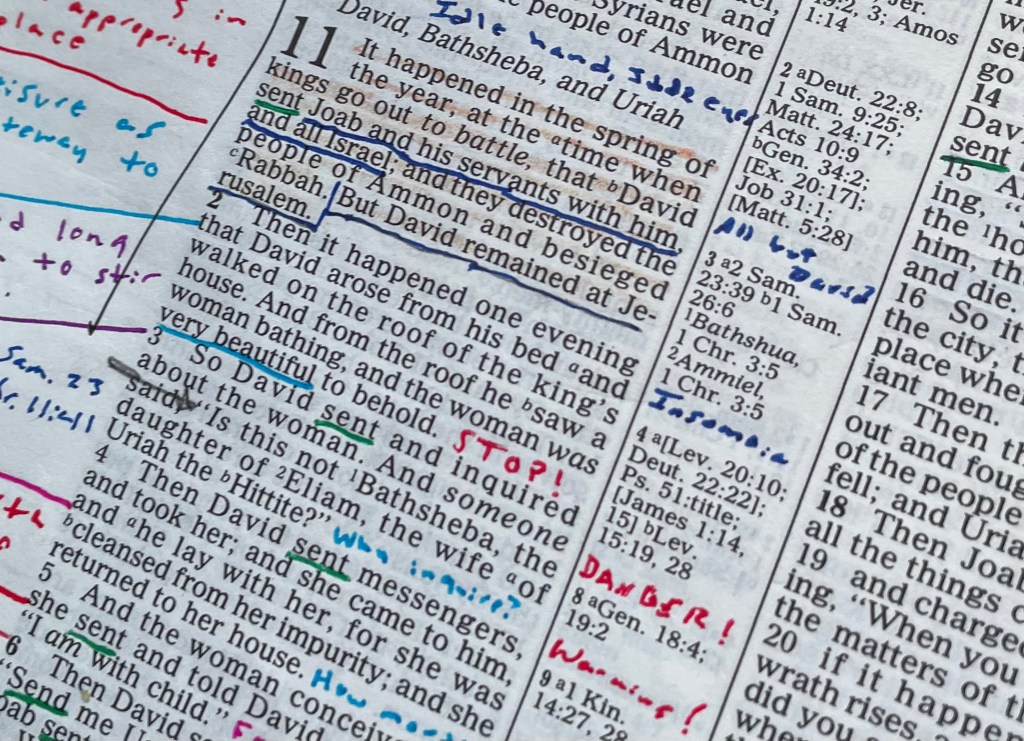
David encountered this in 2 Samuel 11 when his lingering look at a married neighbor led him, this young woman, his adult children, his kingdom, and his godly influence down a terrible path of death and destruction. The writer of this text, guided by inspiration, carefully notes how there were decisive moments when David could have taken a different road but allowed his spiral to continue- he neglected his duty to be with his army, he refused to look away initially, he did not stop gazing but inquired her identity, he failed to dismiss his passions when his servants warned him, and on and on. Even after the initial sin of adultery, the murder, the cover-up, the late-coming guilt- each should have been a flashing warning sign, but his pride and blindness to his own sin were his downfall. Although David came experience God’s grace and forgiveness, the harm from that seemingly causal walk on his rooftop would haunt his own life and that of his family for generations.

A millennia later, the same Spirit led James to write in his epistle, “Let no one say when he is tempted, ‘I am tempted by God’; for God cannot be tempted by evil, nor does He Himself tempt anyone. But each one is tempted when he is drawn away by his own desires and enticed. Then, when desire has conceived, it gives birth to sin; and sin, when it is full-grown, brings forth death.” (James 1:13-15)

The overthrow of our strongly-held beliefs does not happen overnight. The darkness does not need to overwhelm us with the worst of the worst when it comes to temptation; the seeds of doubt, discouragement, and our snares and hang-ups are present in each of us and if we allow them to take root and grow, we all too often find ourselves coping with our pain in unhealthy and unholy ways. The paths that lead to sin are often not striking but subtle, and such temptations prey upon us when we are most worn down and weary.

Each of us will sin and fall short of God’s glory (Rom 3:23), but the off ramps on the highway toward sin are numerous. Ultimately, we cannot blame God or other people or our circumstances for our choices- we must be self-aware enough to see our own weaknesses and humble enough to turn back to God before our sin damages and destroys the very things we hold most dear.