
“Do you want to get well?”


In John 5:6, Jesus asks a man who cannot walk, “Do you want to be made well?”

In context, the question seems odd seeing how we have already been told the man spends his days lying beside a pool renowned for its healing qualities. When we consider that the text says he had been in this debilitating condition for almost forty years, the question Jesus poses almost seems insulting or cruel.

In reality, Jesus can see that the man’s identity is deeply tied to his affliction, the routine it enforces, and the position it has placed him in for so long. Ultimately, Jesus heals the man and sets him free to begin a new life. While this account offers a practical example of the healing/restoring aspects of Christ’s earthly ministry, it also provides insight into our own need for spiritual healing today.

Sometimes we must give up a thing we identify with or take comfort in to begin to recover. In this account, the man was known as the one who lay daily by the pool. He was identified as a long-time lame man for whom his physical lack had become the defining aspect of his life. Not just the severity, but length of time and public place played a role in this reputation.

While we are not all physically marked, we too can gain an identity because of our life circumstances. We all know great high school athletes who are still remembered for their sporting skills decades after leaving the field. We know folks who are always seen as “the life of the party” regardless of how old they are. If we are not careful, we can allow these types of outward reputation to define us inwardly as well. We can get stuck in a familiar identity and find ourselves playing into a set role.

When we encounter Christ, the old self dies, and a new life is begun (Rom 6:1-4). We can no longer live just as we did before but now look to live as embodied examples of Christ (Gal 2:20). We may still look the same physically, but we no longer draw our primary identity from our past reputation, our current positions, or our family connections. In Christ, we are united with all others who have made this commitment regardless of our outward differences (Gal 3:26-29).

In addition to laying the old life down, the new life we are called to demands changes not only our hearts but our public-facing actions. The remains of our old life will seek to cling to us and stereotype us into shame, but as we mature in the Christian life, new thoughts, actions, and habits help to move us forward.

Was I a profane man before? Now I seek to intentionally speak with kindness and grace. Was I always working to pursue my own gain? Now I use my blessings to bless others. Was I known to others as a braggart, a cheat, or a self-righteous critic? I acknowledge these sins, find peace in Christ’s grace, and then move toward repairing relationships with others.

Jesus confronted the lame man because true recovery can only come when we are honest about our need. We can no more fix ourselves spiritually than the man in John 5 could will himself to perfect physical health. Being content to apply a fresh band-aid each day will never heal a deep wound that requires surgery- only when we admit the depth of our need will we admit our own limitations and cry out for His healing. When we come face to face with the Great Physician, may we have the self-awareness to see our deep hurts and receive His compassionate care.
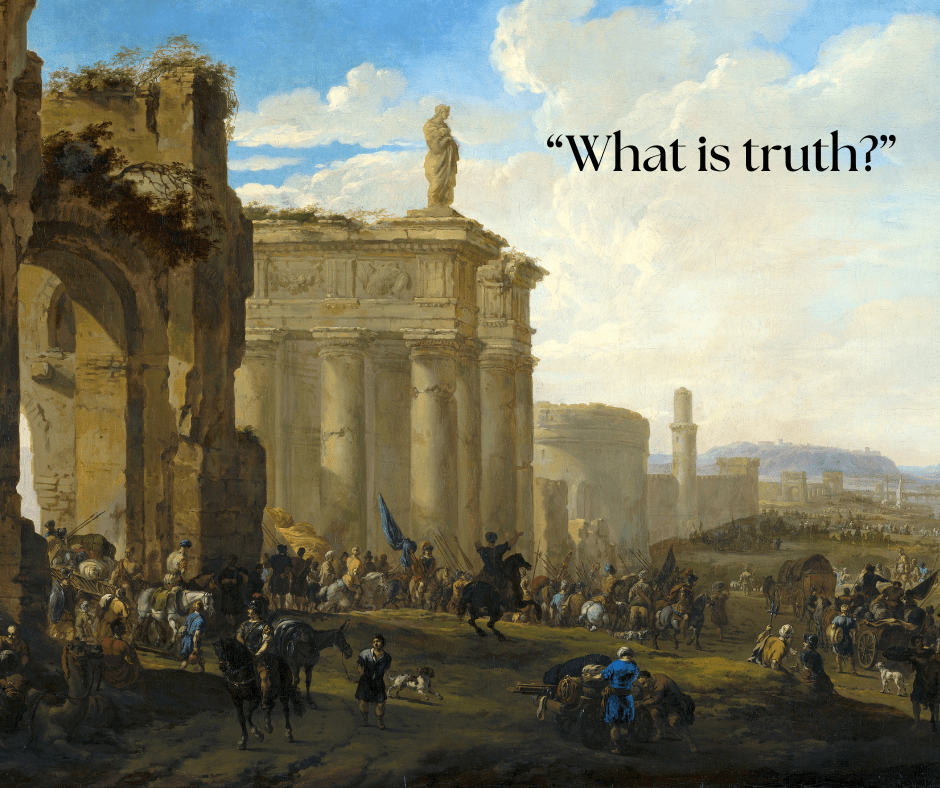
What Is Truth?


Our culture has trained us well to expect a general level of salesmanship, gimmick, and creative accounting in all areas of life. Whether the showroom, the courtroom, the campaign trail, or even the pulpit, we live in a world where far too often realities are stretched and assumptions are left uncorrected in order to gain advantage.

While we might not admit it aloud, we often think of basic honesty as naïve at best. “The world just doesn’t work that way anymore” we think, or we embrace some version of the logic that “honesty may be the best policy, but we aren’t dealing with good people” that allows us to justify our own departures from the truth.

The reality is that some things are true whether I want them to be or not. My opinion on whether or not the laws of gravity apply to me does not impact whether or not I will fall if I slip while on my roof. I may be thoroughly convinced that gravity is not real or that I never granted such an abstract force the right to control my life, but I will still find myself on the ground looking up. Strong commitment is great, but even the most solid commitment to the wrong idea just leaves me sore and corrected by experience.

Jesus and the Roman governor Pilate engage in a revealing conversation in John 18-19. Jesus, having been arrested and falsely accused, is brought before Pilate to receive punishment. It is festival season, and Jerusalem is teeming with hundreds of thousands of weary, foot-sore people already unhappy with Pilate’s rule. In addition to the crowds, the local religious leaders and the figurehead of Rome’s puppet government in the region also have an interest in what happens to Jesus.

Jesus shifts the emphasis from political expediency and Pilate’s desire to be let off the hook to the everlasting mission of God- that God’s Christ would come to proclaim the true reality of God and that all who receive this truth will be a part of God’s kingdom.

Ever the politician, Pilate remarks, “What is truth?”

We don’t know Pilate’s tone, but his subsequent actions indicate he was unwilling to see the Way, the Truth, and the Life standing directly in front of him. Jesus says even Pilate’s authority is not of his own making, and yet Pilate uses his agency to choose the “go along to get along” path rather than to stand for what is true and right. He declares the innocence of Jesus while in the same moment consenting to His death. Truth can be realized in thought, acknowledged in word, and yet still be ignored in action.

Each day, the world around us encourages us to choose what is easy and smooth over what is difficult and may prove dangerous. If we believe that truth is most fully known and experienced in Jesus, will we be willing to stand for what is right when it would be easier to ignore falsehoods and dodge hard conversations? Ultimately, there can be no peace with God and no lasting peace with others without the foundation of truth. May we seek to lay this strong foundation, and having done so, build our lives and character upon it.

Wish I Had Known


Perhaps you have heard folks say, “If I had known it would turn out like this, I would have done some things different.”

While living in regret and focusing only the past are not long-term paths to a healthy life, there is value in being able to see things we did poorly and to use these shortcomings as reminders to keep improving and to encourage others to avoid our mistakes. With a milestone birthday next week, I want to share some thoughts related to the regrets I hear most often and, at times, feel myself.

Maintain the relationships that matter most. As a minister, I have taken part in dozens of funerals and memorial services over the years. While in some ways each grief is personal, one reality I have seen again and again is that our closest relationships are often complex and complicated. No relationship- spouse, parent, child, best friend- stays the same over time. We must come to realize that as our lives change, we must invest time and effort in strengthening the relationships that matter most. We cannot assume that people know how we feel, what we meant, or why we made the choices we did. Making the effort to spend time with the people that matter to us now helps us to build and strengthen bonds across a lifetime. It is easy to allow physical distance, changing circumstances, or a relatively small disagreement to cause a tiny crack that widens over time. In the end, it will not matter how much I achieve if I sacrifice the people that matter most.

Take breaks in the midst of life’s busyness. One challenge facing us and our relationships is the danger of being constantly overextended. While Scripture encourages us to make the most of our opportunities, there is no glory in burning out due to taking on more and more without adequate rest. Each of us need to realize the importance of pacing our lives to finish well rather than to shine only for a short season. Work is an important aspect of life, but we need times of rest and recovery to do our best work. In our modern culture, much of the recreation that we embrace is entered into almost as if it is a career. We spend money, time, and commitment not actually taking a break but cultivating hobbies and interests as intense as our work lives. Every activity should not demand our most intense effort- this realization is not to excuse shoddy work or poor use of time, but a conscious understanding that we must pace our lives with stamina for the long haul rather than attempting such an intensity of activity across all areas of life that can never realistically be maintained.

Realize the value of choosing faithfulness. If we admit we need time to build relationships and yet we are often too busy, these two realizations should cause us to be thoughtful in choosing our priorities. We make choices every day concerning our time, effort, and commitments. What a terrible thing to realize we have worn ourselves out chasing more and more all the while losing out on intimacy in our family, friendships, and our walk with the Lord. Knowing we cannot do everything or be everywhere, we must remember importance of being grateful for our blessings and choosing faithfulness right where we are.

We often convince ourselves that tomorrow there will be more opportunities to tell people how we feel or to better prioritize our lives. Regardless of our stage of life, none of us live with guarantees about the future. With this reality in view, may we resolve to say what needs to be said and to change what needs to be changed starting right now.

How We Hold Together


You have likely seen such vehicles after a big community yard sale. Driven by a person who “was just going to look,” it is now filled with two tables, three mismatched chairs, some assorted shelves, multiple lamps, and several boxes of odds and ends. This bounty is held in the back of the small pickup with bungee straps, some well-worn packing twine, and no small measure of hope. As this heavy-laden truck passes, you think, “There is no way that will hold together.”

When we look at the church as described in the pages of the New Testament, any outsider, even one sympathetic to this new movement, would have taken one look at the odd assortment of people that made up that first Christ-centered community, and thought, “There is no way they will hold together.”

And yet they did- often remarkably well.

We could credit God’s favor on the early church, and Scripture testifies to that reality. It could be pointed out that beginning on the first Pentecost after the resurrection of Jesus the church was blessed with the powerful, miracle-bringing gifts of the Holy Spirit, or the fact that almost all of the original leaders had been personally discipled by Jesus Himself. While all of these factors combined to bless the church, I also believe those early disciples had to choose to stay focused and faithful to their message and this shared message of love, grace, and hope experienced in Christ Jesus not only anchored them in Him- it bound them to each other.

One trait we clearly recognize in the early church was their belief that both blessings and burdens were to be communal experiences. This connection was material and financial, but it was also expressed in deep emotional and spiritual commitments. These first Christians were concerned about the general welfare of the community of faith. In the survival-of-the-fittest world of the Roman empire, a world not all that different from our own, Christians were to be moved by each other’s joys and sufferings. Paul summarized this spirit in the quotable reminder to the congregation at Rome- “Rejoice with those who rejoice, and weep with those who weep” (Rom 12:15).

Not only was the early church emotionally united, they also sought (often imperfectly) to subdue all party spirit to the authority of Christ. Identifiers that shaped their worldviews and relationships outside of the church were to be overwhelmed by the higher calling of devotion to Christ. Paul wrote to the churches of Galatia to remind them that distinctions of ethnicity, gender, and cultural background, while not ceasing to exist outwardly, were to be submitted to the greater unity found in shared commitment to Christ. As long as differences were allowed to hold dominant sway over Christian hearts and behavior, the church struggled, but when such differences were acknowledged as present but placed under Christ’s authority, the church benefited and was blessed by differing perspectives. Ultimately, as a patchwork of different regions, races, and worldviews, the church was forced to confront the reality that, as “the greatest of these,” love must serve to align diverse gifts and perspectives (1 Cor 13).

Today, if we want to hold together and present a united witness to our world, we must love the truth of God’s Word and allow His Word to guide us in loving each other. We hold on to Jesus, and we strive to hold on to each another. This love for God and love for neighbor is the foundation not only of any lasting Christian unity but is also our best hope for a kinder, more grace-filled world.

Slowing Down, Listening Up


While writing in my favorite coffeeshop last week, a professor at our local university who I had not seen recently walked by and said, “Will, it’s good to see you. How long have you been here?”

Thinking he meant serving the church in our community, I replied, “Over 20 years now.”

He gave me a slightly puzzled look.

“I meant in this coffeeshop. I must have missed you when I walked in.”

My answer was accurate, but not accurate for the question he was actually asking. Life can be like that as well; we are giving a right answer, but we have failed to truly understand the nature of the question.

Much of the conflict and confusion in our culture comes from missed (or missing) communication. We spend a lot of time talking, but too often we are talking passed one another. Because we often focus on responding to others rather than reflecting on what they truly mean, we end up confused and frustrated. How can I better hear what others are saying when topics arise where we disagree?

Turn down the temperature. One issue that quickly can sidetrack a conversation is when the level of emotion becomes elevated too quickly. This type of heated exchange fuels cable news, talk radio, and religious discussion boards, but often causes potentially meaningful conversations to fizzle. If I am passionate about an issue, I must also consider that the other person may be just as passionate. This realization is especially helpful if I take the time to realize that I may not be as personally invested in the subject as my counterpart. If we are discussing adoption, I may have many well-researched ideas, but if the person sitting across from me was adopted as a child or is currently in the adoption process after years of infertility, I do not share the same connection to the subject. This realization is not some type of moral relativism, it is simply acknowledging the fact that no two people come to any conversation with the same background, and our experiences deeply shape our thoughts and emotions. The writer of Proverbs 15:1 wisely notes the need to “chill out” before responding in anger and says, “A soft answer turns away wrath, but a harsh word stirs up anger.” When I can pause to gentle and soften the conversation, I stand a better chance of both truly hearing and being heard.

Consider the time and place. It is also important to consider the timing and setting of the exchange. If a person confronts me with an online comment at 2 AM, I won’t see it immediately, can choose to ignore it, or if needed, follow up privately. If a person asks me something in a one-on-one conversation, I have more time and focus to respond well rather than being put on the spot in a larger group like in a staff meeting or church assembly. Not every question merits a response, and not every answer needs to be given in an immediate, public way. Our instant, social media-saturated world tells us that to respond quickly is to win, but the opposite is almost always true. The person who can slow down and consider the best, most helpful way to respond in the specific setting is more likely to make a lasting difference.

When we fail to pay attention to others, we open ourselves up to confusion and conflict. As we live each day, may we seek to imitate the Prince of Peace who understood and modeled the power of listening and faithfully responding to people’s needs in ways that best fit the demands of the moment.

What Matters Most


Because what we focus on determines the way we live, what we place first in our hearts becomes the driving motivation for our daily actions.

What are some questions can we ask ourselves to better realize the forces that dominate our lives?

What are we talking about? We talk mostly about two topics- what we must talk about to live (work issues/schedules/bills) and what we care deeply about in our own hearts. Even as believers, we can spend vast amounts of time each week talking with those around us about sports, entertainment, or politics, and yet spiritual topics seldom arise. Witnessing the overly-aggressive zeal in some religious people may have caused us to give up speaking about spiritual matters all together. While we need to use wisdom and discernment when sharing our faith, it is a sad state when friends, coworkers, and neighbors know much about which team I cheer for, who I vote for, and what music I love, but know little about my commitment to Christ.

How do we spend our money? Another indicator of our focus is demonstrated in how we spend our money. We might spend several hundred dollars on tickets to a favorite concert or sporting event but would balk at giving such a gift to the work of the local church or Christian organization. We spend freely on maintaining our vehicles, eating in restaurants, and impulse buying clothes and decor to fill our homes, yet we seldom open our hearts and wallets to those in need around us. The Scriptures warn us not to set our hope in uncertain riches (1 Tim 6) and that the hoarded wealth we should have shared will witness against us in the judgment (James 5). When those around me see how I spend my money, does my spending show my priority of serving God and others?

Where do we spend our time? As much as conversation and checkbooks, where we spend our time often becomes a visual demonstration of our priorities. Once school, work, and family responsibilities are fulfilled, where am I spending my time?

Recreation is a God-given gift- Jesus and His disciples took times of rest, attended socials gatherings like weddings and feasts, and enjoyed time with friends and neighbors. In our modern world, however, we often sacrifice the spiritual on the altar of the social. While some folks manage this tension well, most of us could honestly admit that we spend more time on our own amusements than on God and His service. When there are opportunities for fellowship with believers, do I seek them out? Do I turn my time in worship into a “punching a clock” obligation that I go to reluctantly and leave quickly to get to other things? Am I willing to spend all day on the lake or at the ballfield or on a shopping trip, but never consider taking extended time to share in a youth event, Christian conference, or special church function? None of us can do all things, and recreation that is not sinful in itself can be done to God’s glory, but the subtle danger is that my personal “me time” will grow more and more self-focused and less God-honoring.

No one is immune from placing self before God. When such misplaced devotion occurs consistently over time, we fail to center our lives as we should, and we live with divided hearts. If our lives do not reflect God as our first priority, may we humbly recognize our error, genuinely repent, and fully refocus our hearts on Him.

Nothing Remains Hidden


In Mark 4:22, Jesus makes a startling declaration, “For there is nothing hidden which shall not be revealed, nor has anything been kept secret but that it should come to light.”

As we look at our own lives, does this revelation from the mouth of Jesus comfort or frighten us?

If you are like me, there is no shortage of situations in the world I do not understand. Despite this fact, I take comfort in knowing while I cannot always discern motives or circumstances, I am not given that responsibility. My role is not to judge or commentate or dismantle the mindsets of those around me; my God-given task is to love others and to serve in ways that both help them and honor God. It is important to realize that neither you or I are alone in this calling- for all the negative things that are often out front in our world, there are countless actions of faithfulness unknown to you and me, yet fully known to God.

The revelation of who we truly served is one aspect of final things that is going to surprise and shock many. In Matthew 25, Jesus tells His hearers in refusing to help others we have in reality refused to help Him, and in serving others, we have actually served Him. One aspect of this passage that is often overlooked is the fact that neither group, those who refuse nor those who help, knew that their attitudes and actions toward “the least of these” were their responses to Jesus Himself.

Jesus comes to us in the circumstances of our daily lives and in the people who cross our paths- in the sick, the broken, the lonely, the hurting, the fearful, the abandoned, the addicted. We are not commanded to accomplish great, impressive feats for others, but we are called to faithfully take action in the opportunities placed into our trust.

No good that we do is ever lost or ever wasted. Even when the external reactions we see appear mixed, small, or hostile, there is value in giving our lives in submission and service. The best part of spiritual work is the part that is known within our hearts and visible only to God. Better to do small actions with good motives than pridefully seek praise and recognition for the good that we do. There will many saints unknown to history who will be rewarded for graciously offering a cup of water in the name of Christ while others who have been praised for piety will be sent away empty.

If we can come to appreciate that no action is unseen by God or forgotten by Him, we can begin to cease striving for others’ constant approval. We can work without fanfare and without the need for acclaim knowing that what seems small and hidden now is fully seen by our good Father.

We usually think of hidden things being revealed in the sense of the classic expression, “your sins will find you out.” While it is true that judgment will reveal the darkness in us all, it will also reveal the many people who have served in quiet, humble, seemingly-forgotten ways and, sometimes without fully realizing it, were serving Jesus all along.

As a disciple, my awareness that God sees me and knows my deepest motivations should cause me to live in such a way that each person I meet can come to see the presence of Christ in all I say and do.

Words That Build Up


We build some structures in our lives understanding that they will be temporary. Children enthusiastically build snowmen in the winter and enjoy constructing sandcastles at the beach. We may be thoughtful in putting up a tent for the night or building a duck blind for a season, but we recognize that the nature of such shelters is fleeting. Because of the limited uses and short lifespan of such projects, we invest in them differently than a home, a church building, or a historic structure.

The words we speak are more permeant than we often admit. When it comes to building others up, we must realize that our words today have the potential to make a difference that will echo in eternity.

Believers should never be guilty of flippantly using cutting phrases, sharp criticisms, or demeaning language toward others. Genuine compliments and encouragement should be the mark of Christian conversation while bitterness, vulgarity, and profanity must be banished from our lips. Words have the power to hurt deeply, and their impact lingers long after the exchange is over. Harsh words can knock down the work of years in a moment, and we as believers are to be builders not bulldozers when it comes to our interactions with others.

The apostle Paul writes in Ephesians 4:29, “Let no corrupt word proceed out of your mouth, but what is good for necessary edification, that it may impart grace to the hearers.”

In speaking into the lives of others, we must look to remove corrupt communication from our lives. While this certainly includes overt profanity and lewd language, it also includes more subtle ways our speech can be used to erode the spirits of others. Gossip, boasting, half-truths, and mocking jokes made at others’ expense are just a sampling of ways our words can hurt.

As believers, we must appreciate that people are not punchlines and that even passing comments leave a lasting impact. Even after decades, we can remember how being teased as a child, mocked as a teenager, or chewed out by our first boss made us feel. We cannot control the words of others, but we can recognize that the words we release into the world are not simply a temporary venting of frustration but have the potential to impact lives far beyond the moment. Rather than being thoughtless or cruel, we should seek “necessary edification”- choosing to build up those around us with intentionally grace-filled speech.

In seeking to build others up, we should look for genuine strengths in the lives of those around us. We live in a social media, cable-news-saturated world that daily attempts to remind us of all the dangers and darkness swirling close by. When it comes to those we are interacting with face-to-face, we can cut through the noise and notice the blessings our family, friends, and neighbors bring into our lives. In conversation, we can choose to be thankful, positive, and kind thereby building a foundation of honoring God and imitating Christ in all our relationships.

We who experience life in Christ are blessed with His presence now and the confidence of joy in eternity, and yet sadly we can often be surly, standoffish, and suspicious. We dare not be known as cynical, critical, and crude in our interactions with others. While no one perfectly tames the tongue in this life (James 3), we cannot allow corrupting speech to become the default pattern of our conversations.

Our words matter, and we must use them as tools to build rather than weapons to wound as we live out our faith each day.

Can You Be More Specific?


With the arrival of the new year, many of us are seeking to form new habits or renew practices to strengthen our walk with Christ. For the believer, prayer forms an important aspect not only of communication but deeper communion with God. Despite our acknowledging the essential nature of prayer, we often struggle to pray consistently.

What reminders can we apply in prayer to reengage when our prayer life has drifted to the dry or stagnant?

When we cannot seem to move beyond the laundry list of needs we often bring to God, it is powerful to stop and rejoice over the many blessings we already experience. Far too often, we give thanks in generalities. While we are indeed grateful for “all our many blessings,” we would grow in gratitude if we approached God at times with no other motive in prayer other than to say “thank you” for the blessings we now have. Rather giving thanks in summary before quickly moving to our remaining needs, I believe it would humble us to count, as the old hymn says, our many blessings, name them one by one, and see what God has done.

In addition to specific thanks, specific requests are vital as we enter God’s presence in prayer. While we certainly appreciate the reality that God knows our needs, the intimacy and comfort found in coming to God is increased when we are not content to pray in the abstract. While we understand the need to for broader, shotgun-like prayers in public settings (“We pray for all those grieving this week.”), our personal, private prayers can be filled with rifle-focused requests (“Lord, I lift up Mary from my high school class who lost her husband of 52 years last week after a long period of poor health. Strengthen her in her grief and in this new reality she is facing.”)

Not only does this specificity connect us more deeply to the people we pray for, but in praying this way, we come to see opportunities to add direct action to our prayers. Remembering people in more specific prayer naturally brings their needs to mind and may lead us to send a card, make a call, pay a visit, or perform a kindness.

Abstraction creates distance. If we pray for “the poor in our community,” we can keep struggling folks at arms-length. If I sit down and begin praying for Mrs. Smith who I know lost her son and is dealing with unexpected funeral expenses, I am much more likely to reach out to help. Both government and large-scale charity organizations are useful for the sizeable problems in our world, but the followers of Jesus must not turn away from praying for and seeking to serve our neighbors.

If we keep people in impersonal categories (the poor, the hypocrites, the liberals, the foreigners, etc.), it makes us much less likely to genuinely pray for or sincerely seek to serve them. The tendency to judge and generalize others is ancient, and it proves to be a damaging and destructive mindset for the people of God in every generation. Intentional prayer that leads us to serve breaks down these barriers and helps us imitate Christ in caring for individual souls rather than faceless crowds.

If we want to give ourselves to prayer in 2024, we make a good start by being more specific- both in the blessings we celebrate and the requests we offer to God.

God knows our hearts, but putting our thoughts into specifics helps us to know ourselves and those we would bless more fully.

Harvest Time Is Here


We find ourselves once again in the midst of the harvest season here in rural West Tennessee.

For the next few weeks, farmers will continue to labor to bring forth from the fields the abundance of what has grown over the last several months. We are blessed to live in an agricultural community- where we live daily in connection with both the bounty and burdens that come with being stewards of the land.

Composed in the midst of agrarian cultures, Scripture turns often to the images of planting, husbandry, and harvest as present physical realities that illustrate eternal spiritual truth. In the narratives of the Bible, sowing, tending, and reaping are near constant themes.

Like our ancestors, we come to appreciate that tomorrow’s harvest is based on yesterday’s labors.

No realistic farmer would live in the expectation of a vast harvest to come unless many hours of preparation and planting had already occurred.

While this may seem obvious to us who are familiar with the sight of planters and sprayers giving way to scenes of combines and cotton pickers as the seasons change, we often ignore this principle spiritually.

Many churches and communities look up one day to appoint new leaders or to recruit new volunteers and realize the preparation for these roles should have been initiated long before the workers were needed.

What holds true in our churches holds true in our own hearts.

If we are unwilling to cultivate our lives faithfully, we should not expect the most fruitful harvest.

God can, and does, bring forth unexpected blessings, but our responsibility to plant faithfully and tend consistently in His kingdom today is His appointed way to prepare the harvest we long to see in the future.

As with physical farming, we also acknowledge that a given season’s harvest is impacted by many factors- some we can control and some we cannot.

Sickness, economics, and the decisions of others can all powerfully affect the outward results of our lives. Despite seeking to be faithful and to lean into God’s leading, we sometimes face tough seasons of loss, hurt, or personal challenges.

Faithful living, like faithful farming, comes by adjusting as best we can to these circumstances we can never fully predict.

The life of faith requires the daily choice to keep trusting and keep working in spite of the unforeseen hardships we face. As believers, we rest in God’s faithfulness, and from this assurance, we labor in love to share His gifts and to bless others day by day.

We also come to understand that the opportunity to harvest must be seized when the time is right.

If we panic and gather too soon, we pick a crop that is immature, not fully formed, and suffer loss. If we wait for perfect conditions to arrive, we risk a crop that is too dry, water-damaged, insect-compromised, or impacted by the coming of winter.

It is the goal of the farmer, as well as the active disciple, to develop an understanding of different soils, seeds, moisture, geography, and weather conditions, and to come to appreciate the “just right” moment to gather in the crop.

When the moment is right, it becomes a race against time and the factors of life to garner in the crop while it will yield the best result.

Such a sense of timing, both in farming and in discipleship, is best gained by imitating those who have gone before and learning through our own experiences over a lifetime of faithful living.

Humanity’s roots in farming are ancient, but the applications we can gain spiritually from observing the physical harvest are as fresh as a crisp fall morning.

May we not neglect to appreciate and value what God’s created order reveals about our own hearts.