What Is Truth?


Our culture has trained us well to expect a general level of salesmanship, gimmick, and creative accounting in all areas of life. Whether the showroom, the courtroom, the campaign trail, or even the pulpit, we live in a world where far too often realities are stretched and assumptions are left uncorrected in order to gain advantage.

While we might not admit it aloud, we often think of basic honesty as naïve at best. “The world just doesn’t work that way anymore” we think, or we embrace some version of the logic that “honesty may be the best policy, but we aren’t dealing with good people” that allows us to justify our own departures from the truth.

The reality is that some things are true whether I want them to be or not. My opinion on whether or not the laws of gravity apply to me does not impact whether or not I will fall if I slip while on my roof. I may be thoroughly convinced that gravity is not real or that I never granted such an abstract force the right to control my life, but I will still find myself on the ground looking up. Strong commitment is great, but even the most solid commitment to the wrong idea just leaves me sore and corrected by experience.

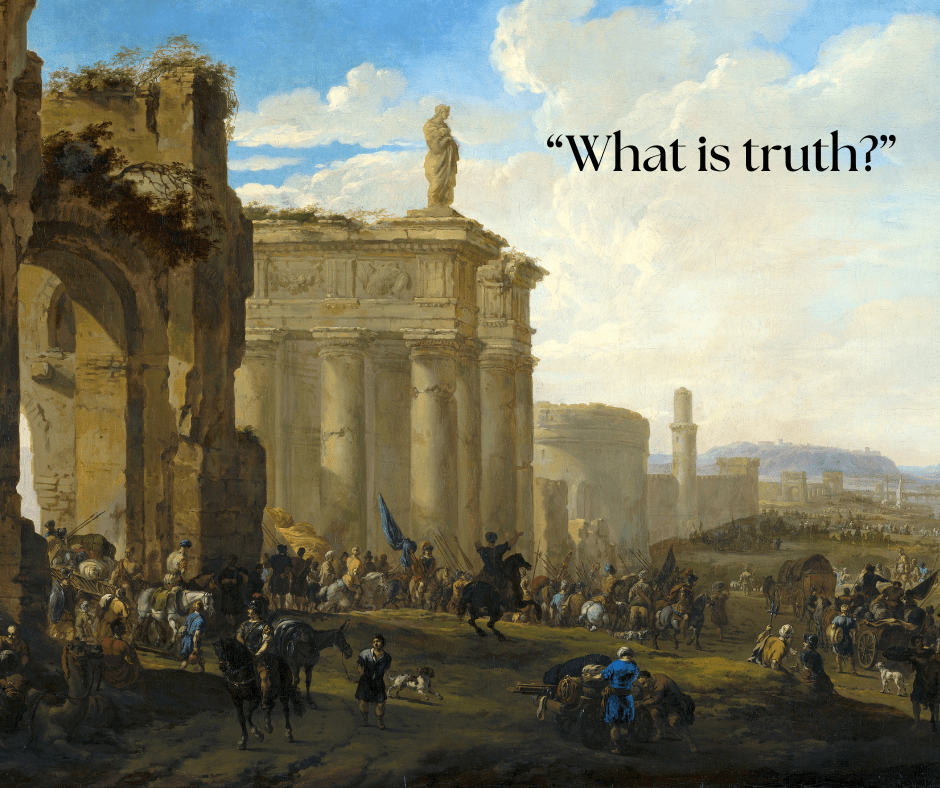
Jesus and the Roman governor Pilate engage in a revealing conversation in John 18-19. Jesus, having been arrested and falsely accused, is brought before Pilate to receive punishment. It is festival season, and Jerusalem is teeming with hundreds of thousands of weary, foot-sore people already unhappy with Pilate’s rule. In addition to the crowds, the local religious leaders and the figurehead of Rome’s puppet government in the region also have an interest in what happens to Jesus.

Jesus shifts the emphasis from political expediency and Pilate’s desire to be let off the hook to the everlasting mission of God- that God’s Christ would come to proclaim the true reality of God and that all who receive this truth will be a part of God’s kingdom.

Ever the politician, Pilate remarks, “What is truth?”

We don’t know Pilate’s tone, but his subsequent actions indicate he was unwilling to see the Way, the Truth, and the Life standing directly in front of him. Jesus says even Pilate’s authority is not of his own making, and yet Pilate uses his agency to choose the “go along to get along” path rather than to stand for what is true and right. He declares the innocence of Jesus while in the same moment consenting to His death. Truth can be realized in thought, acknowledged in word, and yet still be ignored in action.

Each day, the world around us encourages us to choose what is easy and smooth over what is difficult and may prove dangerous. If we believe that truth is most fully known and experienced in Jesus, will we be willing to stand for what is right when it would be easier to ignore falsehoods and dodge hard conversations? Ultimately, there can be no peace with God and no lasting peace with others without the foundation of truth. May we seek to lay this strong foundation, and having done so, build our lives and character upon it.

Prayer for Summertime


O, Lord, Giver of every good gift, we give You thanks for the arrival of a new season of life. Bless us in the coming months with hearts that are aflame with a desire to honor You by serving our neighbors.

Help us to realize that our lives must be yielded to You before they can be laid down and offered for the good of those around us. Give us eyes to see what truly matters and to appreciate the needs next door, down the street, and around the world.

Grant us the wisdom to look beyond the distractions of headlines and status updates and instead to see the real people we encounter day by day who stand in need of care and compassion. May our hearts be filled with tenderness for the struggling among us. Help us not to turn away from those who can be hard to love as we realize our own shortcomings and struggles.

Watch over our young children and teachers as they enjoy their break from school. Be with our teenagers attending practices, traveling to events, and working summer jobs.

We pray a special measure of protection, grace, and courage for those who ending their school days and who are now moving forward to receive further education, to begin their careers, or to start their own families.

Be with the parents who must balance earning a living and making memories with their families. We pray for those striving for a better life as they also seek to support those dependent on them for help. We pray for single adults raising children alone and trying to balance the barrage of summer activities.

Grant mercies to those who are lonely today- may they find the community they long for. Bless those fighting the daily battle with addiction- grant them a measure of strength in this season when social events and vacations can provide added dangers of relapse.

Watch over those working out in the heat and storms of summer- bless the farmers, the linemen, the construction workers, law enforcement officers, and first responders.

Be with the old, the sick, and the infirmed who suffer most acutely during the long days of summer. Keep watch over all those facing the heat of our Southern summer without adequate cooling.

Remind us to look out for each other.

Be with those traveling for work, family, or fun during the coming week and the summer months ahead. Give them traveling mercies for safety as they journey.

Be with our country and community as the summer brings again the focus on politics and power. Help us to keep faith with one another and to extend grace to one another in such tense and troubled days. Let us realize that when the dust of our disagreements settles back to earth, we will be left facing our problems together. May this reality cause us to consider our hearts and give heed to our words even as passions are high and differences great.

Lord, we so often fall short of Your desires for us- we leave undone what we ought to do, and we do things that pull our hearts away from You and from the care we owe to one another. Help us, in ways big and small, to be conformed more and more to the image of Jesus. May this season open our eyes to His will for us.

In His name, amen.

Slowing Down, Listening Up


While writing in my favorite coffeeshop last week, a professor at our local university who I had not seen recently walked by and said, “Will, it’s good to see you. How long have you been here?”

Thinking he meant serving the church in our community, I replied, “Over 20 years now.”

He gave me a slightly puzzled look.

“I meant in this coffeeshop. I must have missed you when I walked in.”

My answer was accurate, but not accurate for the question he was actually asking. Life can be like that as well; we are giving a right answer, but we have failed to truly understand the nature of the question.

Much of the conflict and confusion in our culture comes from missed (or missing) communication. We spend a lot of time talking, but too often we are talking passed one another. Because we often focus on responding to others rather than reflecting on what they truly mean, we end up confused and frustrated. How can I better hear what others are saying when topics arise where we disagree?

Turn down the temperature. One issue that quickly can sidetrack a conversation is when the level of emotion becomes elevated too quickly. This type of heated exchange fuels cable news, talk radio, and religious discussion boards, but often causes potentially meaningful conversations to fizzle. If I am passionate about an issue, I must also consider that the other person may be just as passionate. This realization is especially helpful if I take the time to realize that I may not be as personally invested in the subject as my counterpart. If we are discussing adoption, I may have many well-researched ideas, but if the person sitting across from me was adopted as a child or is currently in the adoption process after years of infertility, I do not share the same connection to the subject. This realization is not some type of moral relativism, it is simply acknowledging the fact that no two people come to any conversation with the same background, and our experiences deeply shape our thoughts and emotions. The writer of Proverbs 15:1 wisely notes the need to “chill out” before responding in anger and says, “A soft answer turns away wrath, but a harsh word stirs up anger.” When I can pause to gentle and soften the conversation, I stand a better chance of both truly hearing and being heard.

Consider the time and place. It is also important to consider the timing and setting of the exchange. If a person confronts me with an online comment at 2 AM, I won’t see it immediately, can choose to ignore it, or if needed, follow up privately. If a person asks me something in a one-on-one conversation, I have more time and focus to respond well rather than being put on the spot in a larger group like in a staff meeting or church assembly. Not every question merits a response, and not every answer needs to be given in an immediate, public way. Our instant, social media-saturated world tells us that to respond quickly is to win, but the opposite is almost always true. The person who can slow down and consider the best, most helpful way to respond in the specific setting is more likely to make a lasting difference.

When we fail to pay attention to others, we open ourselves up to confusion and conflict. As we live each day, may we seek to imitate the Prince of Peace who understood and modeled the power of listening and faithfully responding to people’s needs in ways that best fit the demands of the moment.

What Matters Most


Because what we focus on determines the way we live, what we place first in our hearts becomes the driving motivation for our daily actions.

What are some questions can we ask ourselves to better realize the forces that dominate our lives?

What are we talking about? We talk mostly about two topics- what we must talk about to live (work issues/schedules/bills) and what we care deeply about in our own hearts. Even as believers, we can spend vast amounts of time each week talking with those around us about sports, entertainment, or politics, and yet spiritual topics seldom arise. Witnessing the overly-aggressive zeal in some religious people may have caused us to give up speaking about spiritual matters all together. While we need to use wisdom and discernment when sharing our faith, it is a sad state when friends, coworkers, and neighbors know much about which team I cheer for, who I vote for, and what music I love, but know little about my commitment to Christ.

How do we spend our money? Another indicator of our focus is demonstrated in how we spend our money. We might spend several hundred dollars on tickets to a favorite concert or sporting event but would balk at giving such a gift to the work of the local church or Christian organization. We spend freely on maintaining our vehicles, eating in restaurants, and impulse buying clothes and decor to fill our homes, yet we seldom open our hearts and wallets to those in need around us. The Scriptures warn us not to set our hope in uncertain riches (1 Tim 6) and that the hoarded wealth we should have shared will witness against us in the judgment (James 5). When those around me see how I spend my money, does my spending show my priority of serving God and others?

Where do we spend our time? As much as conversation and checkbooks, where we spend our time often becomes a visual demonstration of our priorities. Once school, work, and family responsibilities are fulfilled, where am I spending my time?

Recreation is a God-given gift- Jesus and His disciples took times of rest, attended socials gatherings like weddings and feasts, and enjoyed time with friends and neighbors. In our modern world, however, we often sacrifice the spiritual on the altar of the social. While some folks manage this tension well, most of us could honestly admit that we spend more time on our own amusements than on God and His service. When there are opportunities for fellowship with believers, do I seek them out? Do I turn my time in worship into a “punching a clock” obligation that I go to reluctantly and leave quickly to get to other things? Am I willing to spend all day on the lake or at the ballfield or on a shopping trip, but never consider taking extended time to share in a youth event, Christian conference, or special church function? None of us can do all things, and recreation that is not sinful in itself can be done to God’s glory, but the subtle danger is that my personal “me time” will grow more and more self-focused and less God-honoring.

No one is immune from placing self before God. When such misplaced devotion occurs consistently over time, we fail to center our lives as we should, and we live with divided hearts. If our lives do not reflect God as our first priority, may we humbly recognize our error, genuinely repent, and fully refocus our hearts on Him.

Prayer for Stormy Times


Father God, the weather is unpredictable, but we know that You are constant and ever-sure.

Like the spring, we too are inconstant; often blown off course and shifting in the challenges and trials of life.

You know our frame, our limitations, our weaknesses. Despite our defenses, we falter, fail, and fall.

Help us to see that our effort at self-defense always leaves us short of the deliverance that can only be experienced in surrender to You. Give us the ability to see the folly of resisting our great need for Your divine care and grace in each moment of our lives.

Even we who long to reach upward can never scale to the perfect heights we seek. We give thanks that in lovingkindness You descend to us.

In the blessings of our daily experiences, in the bold assertions of Your word, in the beautiful community of the church- You show us more of what we can be.

Yet these gifts would be nothing without the Giver.

Incarnate in Bethlehem, walking in Galilee, dying outside Jerusalem, rising in power to die no more.

In Jesus, You come among us clothed in the dust and ashes of creation.

You do not offer an absentee love, but place the fullness of Yourself in our midst.

To the vulnerable, You are a protector.

To the self-sufficient, You are a servant.

To the prideful, You are a warning.

To the broken, You are a healer.

To the burdened, You are a liberator.

To the hungry and hopeless, You are Daily Bread and Living Water.

To the lost, You are the Way, the Truth, and the Life.

In Your grace, You choose to place Your love upon us. You extend constant sustaining blessings and the opportunity for salvation.

What more could You do to give Yourself to us and for us?

Help us to see this love. Help us to accept it. Help us to experience it more and more fully, and help us to live our lives in response to it. In this season, let us choose to pass forward the love we have received.

In tense times and uncertain days, may our lives be marked by a Christ-like humility that silences the mouths of critics and opens the hearts of cynics.

Let us not be bewitched by power nor lulled into passivity. Give us the courage to withstand the assaults of enemies and the compromises of friends. Grant us, as Your people, the ability to shine light into the darkness.

Let us not be tossed by the stormy winds that threaten from both within and without, but let us instead be fixed and anchored to a love that cannot be shaken and will not be moved.

In Christ’s holy name and through His power we pray, amen.

In Praise of Small Places


“Can anything good come out of Nazareth?”

This question comes from the lips of Nathanael, a man whom Jesus Himself would commend for being a straight talker (John 1:46-47). Today Nazareth is a predominantly Muslim city of nearly 80,000 people in northern Israel. Modern Nazareth also has a large Christian population and the city benefits from tourism centered around the New Testament testimony of ancient Nazareth as the hometown of Jesus. If you are familiar with Scripture and remember the town’s name, you most likely think of Nazareth in the context of the oft-repeated designation of our Lord as “Jesus of Nazareth.”

Today, Nathanael’s incredulity at the origins of the Messiah seems out of place. After all, 80,000 people is well more than double the entire population of Weakley County, yet in its day, Nazareth was a tiny village- neither David’s birthplace (Bethlehem) or the home of God’s temple (Jerusalem). Nathanael raises an honest question, “How could someone so great and so important come from such a small, forgotten place?”

I admit I hold a great affection for small places. I have lived in four towns in my four decades of life- all in West Tennessee and each with less than 3,000 residents. While I have been blessed to travel to some of the largest cities in the world and enjoyed those visits, I have returned here again and again. I will be the first to confess small places are not perfect- in fact, they hold the same challenges as cities even if harder to recognize. Small towns can serve as strongholds of hypocrisy, islands of poverty, dens of crime, and homes to violence. Hard times hit small places hard- when factories close, when younger generations move away, when addictions arrive to fill the emptiness and loneliness of hurting people.

Despite the struggles, I believe there is value in the intimacy of such a life.

To know the names of the people you meet each day at the store and in the bank- to love them as your parents loved their parents as your grandparents loved their grandparents. To shop local because you know the family’s youngest daughter got braces last week or because their uncle passed suddenly and you want to help with expenses. For an old man to remind you of what a great athlete your daddy was or to thank you for your grandfather’s service in the war. To be told you come from good stock or to be praised for overcoming a tough upbringing. To hear the same stories again and again, and although you were born fifty years after the fact, you feel like you saw the drought, the winning shot, or the great fire. To see hardworking people slip a few bills into a young father’s hand when he was short at the store- careful not to let his children see that he had come to the end of his money but not to the end of the month. To know those church ladies armed with worn Bibles and well-used casserole dishes who always whispered to the young teachers each August, “If you have any children in your class who need anything, you just let me know.”

No place is perfect. Even in small places, we face challenges to fund and feed and fix, and we often disagree on how best to do that. We have many differences in how we think, worship, vote, and live, yet we should not be surprised that the Man who taught us to love God and to love our neighbor came from a place where He would have known His neighbors by name.

When we are committed to loving God and serving where He has planted us, good things will continue to come from the least likely places.

Near to the heart of God


In times of uncertainty and pain as well as seasons of joy and calm, our daily goal as believers should be to draw nearer to the heart of God. We do this though paying attention to our emotions, filling our minds with Scripture, serving others, and lifting up our hearts in prayer.

I offer this prayer this week, and I hope you will use/adapt its words to fit the particular challenges and celebrations you may be facing today.


Lord, we ask to receive and acknowledge the appointed blessings You offer us this day. Help us not to grasp and grab, but to open our hearts and our hands to gratefully accept all that You seek to provide.

Grant us the ability to see the good around us and to praise You for it.

Help us to see blessings even in the midst of life’s burdensome seasons. Give us the awareness to appreciate grace even when it comes disguised as hard work, disappointment, or loss.

We would ask for the ability to see and discern what is best and most aligned for Your will for our lives.

Lord, help us to see ourselves.

Allow us to be honest and open with both our gifts and with our shortcomings.

Help us to realize and repent when we embrace paths that do not lead us into closer communion with You. Strengthen us to turn from such dangerous distractions and self-focused aims.

Only in appreciating our own weakness can we truly recognize our need to walk in continuous relationship with You.

We ask that our hearts would continually be open to Your nearness, and in this awareness, may we seek to share our hope with others.

We pray for the people we encounter each day- whether family in our homes or strangers on the street.

For those who do not know You, we pray for open eyes, open hearts, and opportunities to be impacted through the goods news found in Christ.

If we are knowingly living in rebellion to Your will, please draw us to Yourself through the message of the Word, faithful friends, and the conviction of conscience.

Give us the ability to live by faith- not rooted in our own self-will, but in every way aligned more and more to Your will for us.

Help us to praise the good works going on around us regardless of who will receive the credit. Allow us to be people who look to encourage rather than those who constantly seek to find fault. Help us to stay caring and curious as we navigate our way through this life.

Do not let us grow weary in doing good, but rather help us to develop the rhythms and practices we need to remain healthy even as we seek to serve the struggling. Give us an openness and awareness of people’s needs as we walk through life. Help us to observe and to inquire for ways to help and let us do this for people’s good and Your glory.

As we draw near to You, help us to see that such a focus allows us to draw near to others. Help us, like Jesus, to offer welcome and hope to the world that arises out of an assurance and connection to You.

In Christ’s name, amen.

FRAGILE: Handle with care


Ann Marie recently received a set of lamps as a Christmas gift. After the holiday, I decided to unbox the lamps and set them up. The process was straightforward- remove the lamps from packaging, perform minimal assembly, put in the bulbs, plug into the outlet, and the light would shine.

Only when I began my project did I notice how heavily wrapped and tightly secured the lamps were inside layers of protective packing materials. All over the box was the warning: FRAGILE: HANDLE WITH CARE. Rather than forcibly breaking into the boxes, I followed the advice and carefully cut away the outer wrappings. The delicate vase-like base of each lamp was still intact, and due to the helpful warning, I was able to appreciate the need for extra care as I assembled the lamps.

When we handle precious, breakable, or valuable objects, we understand it is worth being careful to prevent loss and avoid unnecessary damage. What is a more valuable combination than the Word of God applied to a human soul?

In Christ, we have been blessed with “exceedingly great and precious promises” in Christ (2 Pet 1:4). Because these gifts come from God and are essential in carrying His message to the wider world, we must take care in how we use and handle these blessings. If we do not live out of a grounding in the reality of God’s promises, we quickly drift from His will for us. It is our living out of the Christian message, not our words in isolation, that ultimately influences others for Christ.

Sometimes when meeting a person for the first time, the topic of faith arises. Often, people noticeably shift and even bristle when belief and church life are shared as positives. Sadly, abuse cover-ups, financial corruption, moral scandals, and general mean-spiritedness are associated by many people with the label of Christian. While we might feel that such analysis is not fair, we would be foolish as believers not to acknowledge and admit the many well-known cases of those who have publicly presented Christ violating the trust and breaking the faith with large numbers of people. We know that on a smaller scale, local churches, families, and individuals at times have used the name of Christ as cover for great wrongs.

When it comes to handling the richness of the gospel, our words and actions must be considered with care. In the words of Jesus, we must be “wise as serpents and as harmless as doves” (Mt 10:16). As Paul wrote we must, “Let your speech always be with grace, seasoned with salt, that you may know how you ought to answer each one” (Col 4:6). We should seek to adopt the manner of Jesus who, while upsetting the corrupt and abusive religious practices of His day, also displayed a compassion for individual souls that allowed it to be poetically said that He would not break a fragile spirit or snuff out the smallest flame of faith (Mt 12:20). In sharing the message of Jesus, we must be able to convey that apart from Him we have no hope, yet speak in a way that does not despair but points to God’s grace.

This week, may we remember that the good news we hold is precious, and we must steward it faithfully. May we also realize that many people around us are fragile and have been broken by the hardships of life and have become disillusioned with faith. As we seek to offer God’s precious message to broken and bruised people, may we lean on the example of Jesus and speak the truth in a way that draws the hurting to Him.