Near to the heart of God


In times of uncertainty and pain as well as seasons of joy and calm, our daily goal as believers should be to draw nearer to the heart of God. We do this though paying attention to our emotions, filling our minds with Scripture, serving others, and lifting up our hearts in prayer.

I offer this prayer this week, and I hope you will use/adapt its words to fit the particular challenges and celebrations you may be facing today.


Lord, we ask to receive and acknowledge the appointed blessings You offer us this day. Help us not to grasp and grab, but to open our hearts and our hands to gratefully accept all that You seek to provide.

Grant us the ability to see the good around us and to praise You for it.

Help us to see blessings even in the midst of life’s burdensome seasons. Give us the awareness to appreciate grace even when it comes disguised as hard work, disappointment, or loss.

We would ask for the ability to see and discern what is best and most aligned for Your will for our lives.

Lord, help us to see ourselves.

Allow us to be honest and open with both our gifts and with our shortcomings.

Help us to realize and repent when we embrace paths that do not lead us into closer communion with You. Strengthen us to turn from such dangerous distractions and self-focused aims.

Only in appreciating our own weakness can we truly recognize our need to walk in continuous relationship with You.

We ask that our hearts would continually be open to Your nearness, and in this awareness, may we seek to share our hope with others.

We pray for the people we encounter each day- whether family in our homes or strangers on the street.

For those who do not know You, we pray for open eyes, open hearts, and opportunities to be impacted through the goods news found in Christ.

If we are knowingly living in rebellion to Your will, please draw us to Yourself through the message of the Word, faithful friends, and the conviction of conscience.

Give us the ability to live by faith- not rooted in our own self-will, but in every way aligned more and more to Your will for us.

Help us to praise the good works going on around us regardless of who will receive the credit. Allow us to be people who look to encourage rather than those who constantly seek to find fault. Help us to stay caring and curious as we navigate our way through this life.

Do not let us grow weary in doing good, but rather help us to develop the rhythms and practices we need to remain healthy even as we seek to serve the struggling. Give us an openness and awareness of people’s needs as we walk through life. Help us to observe and to inquire for ways to help and let us do this for people’s good and Your glory.

As we draw near to You, help us to see that such a focus allows us to draw near to others. Help us, like Jesus, to offer welcome and hope to the world that arises out of an assurance and connection to You.

In Christ’s name, amen.

FRAGILE: Handle with care


Ann Marie recently received a set of lamps as a Christmas gift. After the holiday, I decided to unbox the lamps and set them up. The process was straightforward- remove the lamps from packaging, perform minimal assembly, put in the bulbs, plug into the outlet, and the light would shine.

Only when I began my project did I notice how heavily wrapped and tightly secured the lamps were inside layers of protective packing materials. All over the box was the warning: FRAGILE: HANDLE WITH CARE. Rather than forcibly breaking into the boxes, I followed the advice and carefully cut away the outer wrappings. The delicate vase-like base of each lamp was still intact, and due to the helpful warning, I was able to appreciate the need for extra care as I assembled the lamps.

When we handle precious, breakable, or valuable objects, we understand it is worth being careful to prevent loss and avoid unnecessary damage. What is a more valuable combination than the Word of God applied to a human soul?

In Christ, we have been blessed with “exceedingly great and precious promises” in Christ (2 Pet 1:4). Because these gifts come from God and are essential in carrying His message to the wider world, we must take care in how we use and handle these blessings. If we do not live out of a grounding in the reality of God’s promises, we quickly drift from His will for us. It is our living out of the Christian message, not our words in isolation, that ultimately influences others for Christ.

Sometimes when meeting a person for the first time, the topic of faith arises. Often, people noticeably shift and even bristle when belief and church life are shared as positives. Sadly, abuse cover-ups, financial corruption, moral scandals, and general mean-spiritedness are associated by many people with the label of Christian. While we might feel that such analysis is not fair, we would be foolish as believers not to acknowledge and admit the many well-known cases of those who have publicly presented Christ violating the trust and breaking the faith with large numbers of people. We know that on a smaller scale, local churches, families, and individuals at times have used the name of Christ as cover for great wrongs.

When it comes to handling the richness of the gospel, our words and actions must be considered with care. In the words of Jesus, we must be “wise as serpents and as harmless as doves” (Mt 10:16). As Paul wrote we must, “Let your speech always be with grace, seasoned with salt, that you may know how you ought to answer each one” (Col 4:6). We should seek to adopt the manner of Jesus who, while upsetting the corrupt and abusive religious practices of His day, also displayed a compassion for individual souls that allowed it to be poetically said that He would not break a fragile spirit or snuff out the smallest flame of faith (Mt 12:20). In sharing the message of Jesus, we must be able to convey that apart from Him we have no hope, yet speak in a way that does not despair but points to God’s grace.

This week, may we remember that the good news we hold is precious, and we must steward it faithfully. May we also realize that many people around us are fragile and have been broken by the hardships of life and have become disillusioned with faith. As we seek to offer God’s precious message to broken and bruised people, may we lean on the example of Jesus and speak the truth in a way that draws the hurting to Him.

Making It Look Effortless?

Recently I heard an older woman praising a young mom’s ability to manage multiple family, work, and social responsibilities with the exclamation, “You just make it all look so effortless!”

We understand what she actually meant: “You are so talented and skilled at difficult things that it seems like you don’t even have to try very hard. You’re great!”

We know this compliment is intended as praise- the young mother appeared so skilled at managing multiple challenges that her busy life appeared to others to naturally flow with ease and grace. In reality, the busy mom was no doubt getting up early, dealing with stress related to her children and job, facing the daily struggles of life, relationships, and faith even as she “made it look easy.”

Appearances and reality are often not completely congruent- what others see may not be the entire truth of what we are experiencing as we live out our lives. Some folks around us seem to have it all together, but may actually be falling apart. Others are facing extreme outward challenges with their health, finances, or relationships, but may, in reality, have a deep sense of peace abiding within.

In a passing moment, our perceptions of others are often inaccurate and incomplete.

When we think of Moses, we think of a strong, fearless leader standing before Pharaoh demanding freedom for God’s people, but Scripture goes out of the way to show he was reluctant to accept his call to leadership and consented only once his more eloquent brother Aaron was allowed to be his spokesman. Elijah, who projected prophetic strength in public, was often despondent and discouraged before God. Paul confessed that his many persecutions and concerns for the churches he had planted were sources of anxiety for him and would have overwhelmed him had Christ Himself strengthened and sustained his ministry.

No one is quite as “together” as they seem to the watching world.

In Scripture, women often shine as examples of understated strength. In a culture where they were often in the background, women rise up and are held out to us as heroes of faith.

Rahab, a foreigner with a questionable line of work, becomes the lifeline for God’s people as one who acted in faith and whose name is eventually found in the genealogy of Jesus. Ruth, also an outsider, demonstrates the ability to care for an aged mother-in-law, to be the breadwinner of her household, and to secure a future for herself and her family with her godly character. Esther stands up to law, custom, and the whims of a fickle husband to intercede for her people in their darkest hour. Women are present throughout the ministry of Jesus and the remainder of the New Testament- hosting, financing, worshiping, teaching, and connecting the congregations of the early church.

A faithful life is never effortless for anyone regardless of what appears on the surface. The life of faith is an active one as we seek to grow in grace and serve others, but such commitment is worth our energy and effort as we seek to live for Christ.

May we look for faithfulness in unexpected places this week, and praise it when we find it.

May our own focus be more on building our inner character over maintaining our outward comfort.

When we willingly press further into God’s service by making an effort to use the gifts He provides, He gladly gives us the strength to joyfully live by faith.

God of all questions…

Perhaps you have heard well-meaning folks facing difficult circumstances say, “Well, it’s just God’s will, and we can’t question it.”

We may have at times even expressed this idea ourselves. This statement usually arises from a mindset that trusting God without irreverently seeking to understand the deep mysteries of His ways is the marker of a genuine faith.

While this logic often springs from a sincere heart, is this the way we are intended to understand faith? Does biblical faith require us to suspend our questions?

If faithful people are never supposed to ask questions, none of our faith heroes were actually very faithful- Abraham (Gen 15:2), Moses (Exodus 3-4), David (Ps 22:1), and even Jesus (Mt 27:34) all expressed a questions desiring to know the Father’s will more fully. If Jesus, echoing David, could so publicly question His Father in the midst of His greatest trial, why do we so often presume that questioning why things happen is a sign of a weak faith?

Their questions were not a sign of a lack of faith, but a sign of a lack of clarity of why God had called them to a particular task or how a particular challenge was to be resolved. The questions were not just to gain information, but to more fully understand the why of their circumstances.

They actively wondered how a righteous God could (or would) bring about the very promises He had given when their outward circumstances seemed to declare just the opposite result was occurring. Do you ever wonder that too? I sure have at different points in my life.

In Judges, Gideon asks the Angel of the LORD, “O my lord, if the Lord is with us, why then has all this happened to us?” And where are all His miracles which our fathers told us about, saying, ‘Did not the Lord bring us up from Egypt?’” (Judges 6:13) Is there an accusation in this query? Absolutely- at least on one level, but could his question not also be seen as confusion, frustration, or grief? Gideon believes the LORD has forsaken His people, and he lays his questions before God.

The LORD does not given Gideon a lecture; He instead empowers him with a clarifying mission. Often the answers we seek come not through a bright light of enlightenment but through a call to obedience and a reminder of God’s overarching promise that He will act for His glory and our good.

Sometimes Scripture answers questions by direct words or through the examples of others (Ps 119:105). Sometimes life’s circumstances resolve in such a way that we can seem to perceive the guiding hand of Providence working for our good (Rom 8:28). And sometimes the answers do not come, but we are the better for having asked the questions. If we learn more about God’s nature and our own spiritual journey through the process of questioning and struggle, may be the answer is not a single clean-cut truth, but the faith that emerges only through enduring the valleys of experience.

Paul writes in 1 Cor 13:12 that, “for now we see in a mirror, dimly, but then face to face. Now I know in part, but then I shall know just as I also am known.” The fact we can only see dimly shouldn’t stop us from looking for God and examining our own lives as we seek to conform them to His will.

The promise of faith becoming sight should be seen an invitation to keep searching and wrestling with our faith- not an excuse to avoid exploring our hearts and seeking to know God more fully simply because our understanding in this moment is limited.

I believe that, by faith, one day we will know all we need to know, but until then may we have the courage to keep questioning and the conviction that He will answer in all the ways we most need here and now.

The everyday nature of greatness…

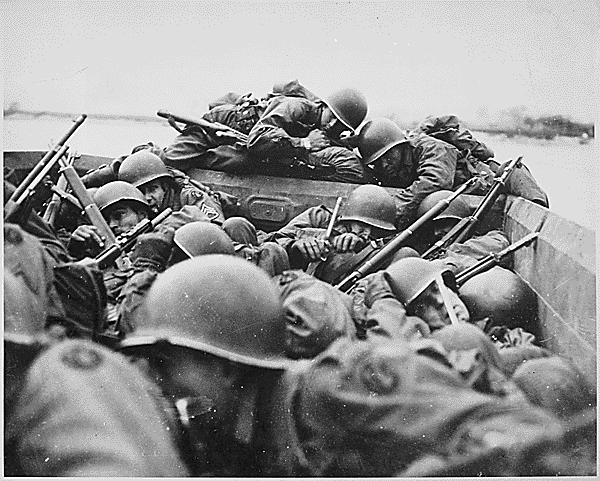
Image credit: National Archives. Crossing the Rhine under enemy fire at St. Goar- March 1945. ID: 535978

The Second World War ended almost 80 years ago. While thousands of books, films, and accounts of the conflict have been recorded, each day fewer people who experienced combat and their loved ones who lived through the conflict on the home front remain. Only a few years at most remain until the last members of America’s “greatest generation” pass from this life.

These brave men and women did more than protect the dream of democracy and liberate the world from tyranny- they also form the last living link with the devastation of the Great Depression and the economic rebuilding and social restructuring of America. Many of these same individuals became our social, political, and religious leaders who impacted the following decades through the Civil Rights era, the space race, and the explosion of new cultural movements and technological advances. People who were taught in one room schoolhouses saw the results of the atomic bomb, watched a man walk on the moon, and now can FaceTime their great-grandchildren on the other side of the world in an instant.

Every nation and every community have larger-than-life figures who tower over their history. Sometimes these men and women are politicians or war heroes or long-serving monarchs. Communities of believers have these people turned legends as well. Augustine, Luther, Wesley, Spurgeon, Mother Teresa, Martin Luther King, Jr., Billy Graham- such names evoke powerful memories among those who study church history. While such men and women were far from perfect, they each left a legacy that impacted the spiritual lives of millions. While it is unlikely that we will never achieve worldwide recognition, none of us is without influence. As we live from day to day, we are each crafting our personal legacy of faith.

Are you caring for a preschool-age grandchild a few times a week? Your attitude and influence will shape that child forever. Do you teach a Bible class to a half dozen seemingly-disinterested teenagers each Sunday morning? Some of those young people will grow up and remember not just the facts you shared, but the memory that you showed up week by week and sought to share the love of Jesus with them. Our impact is not always seen instantly or even measured in the course of our lives, but it touches eternity.

While we do not all have the measure of ability, each of us is charged with serving faithfully wherever he or she is planted.

You may not be gifted for greatness in the kingdom, but you are gifted for faithfulness- and faithful is what we are ultimately called to be.

Whether we are preaching to thousands from a prominent pulpit, influencing millions from bookstore shelves, or showing up to patiently love and minister to the handful of saints gathered in a rural congregation, it is not the size of the crowd, but the condition of the heart that determines faithfulness.

We do not look upon the photographs of D-Day or Iwo Jima, see the bravery there, and say “Well, those guys weren’t the generals or admirals or presidents or prime ministers, so they really didn’t matter.” Such a pronouncement would be blasphemy. It would disparage the faithful service of the very people who directly sacrificed the most in a vital moment in the world’s history. While political officials and military commanders were essential, the masses of the almost unknown soldiers were the key to lasting victory.

In the same way, God looks at His kingdom and sees value in each person. No one is nameless or small or insignificant in the kingdom of God. Honored professors, beloved authors, and celebrity preachers have their place, but the vital work of discipleship and ministry is most often carried out by unknown believers in overlooked places never seen by the majority of the watching world.

May we remember the truly great people that helped shape us into we are, and may we seek to use our gifts, whatever their shape or size, to pass on our blessings. We should never forget that our gifts, which may seem to us so very small, can be used for great good when we are willing to yield them faithfully in service to Christ.

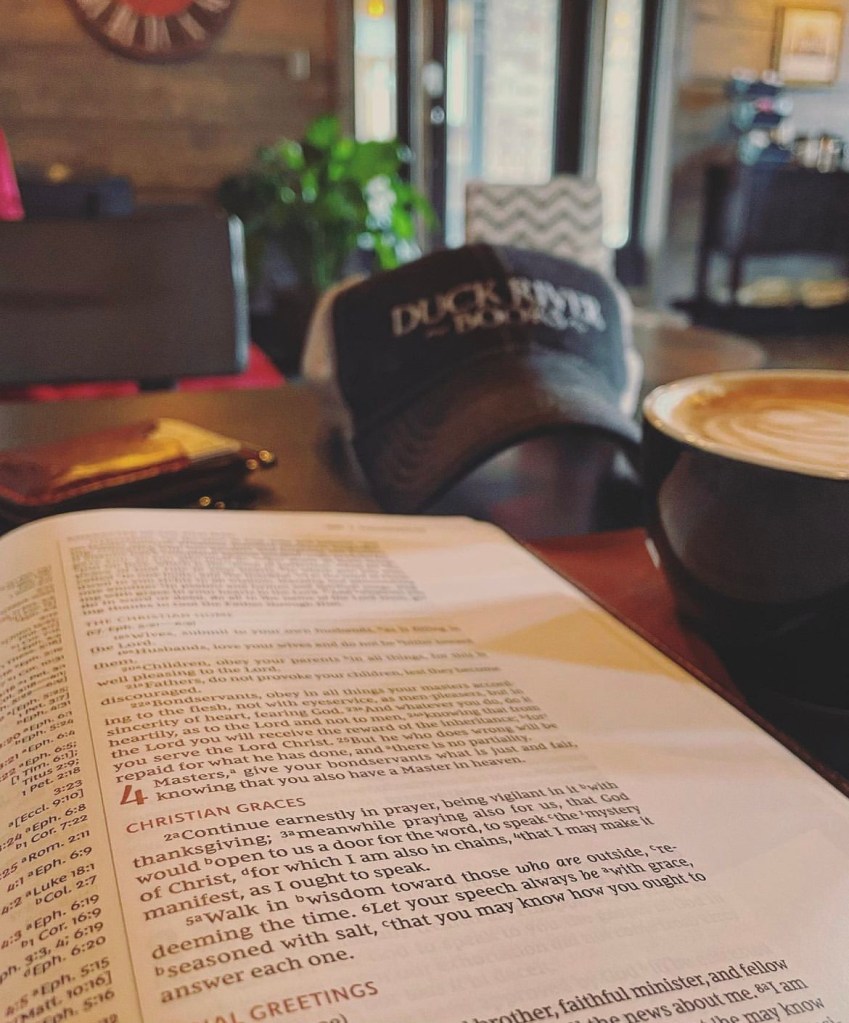
Coffeeshops & redeeming the time…

For Jarrod Bailey

At times, I overhear some pretty intense conversations in coffeeshops.

Some are romantic, some are financial, and, of course, some are religious.

With each passing year, I realize more and more that now in my late thirties, I am just starting to truly learn to listen with less judgment and more grace. At times, I hear echoes of my own old bravado and the absolute certainty so present in younger voices- a boldness that I now recognize so often hides pain, shame, and fear.

We tend to get louder when our own arguments start to cave in around us.

Assurance seldom shouts.

Now when I hear arguments I might have tried to win 20 years ago or may have rolled my eyes at ten years ago, I just seek to listen and try not to interfere too much with the process of growth in others.

My faith is central to me, but life is teaching me- mostly through its trials and my own errors- that presence and patience and the passage of time often prove far more essential to lasting clarity than my knee-jerk sharing of self-pious platitudes or one-size-fits-all certainties. Growth and maturity almost always seem to take time, experience, and some good old-fashioned failure.

I can’t endure that process for anyone else.

Neither can you.

At this point in my life, it’s becoming less and less about winning arguments or calling out every perceived act of arrogance or error, and it’s becoming more and more about showing up faithfully, listening patiently, and loving fully.

It’s that simple and it’s that hard- and, as a friend of mine would say, it’s amazing and it’s awesome.

I can do it, and you can too.

There’s always a seat at the table, and the coffee’s always on.