
Beloved of the Father


One of the driving themes of Scripture is the ongoing relationship of God with His people. Whether as the LORD Almighty of the prophet’s vision (Isa 6), the God-Who-Sees Hagar’s distress (Gen 16), or the Babe of Bethlehem (Mt 1-2), our God shows up again and again both in power and in proximity. Despite lacking nothing, God is constantly moving toward relationship. In this reality, God more fully reveals His desire for community. Not only does He seek us and nearness to us, there is an eternal relational aspect present within God’s nature as Father, Son, and Spirit.

With Father’s Day this Sunday, many people will be reflecting on their relationships with their earthly fathers. Some kids are picking out BBQ supplies or golf balls to surprise their dads while others are wondering where their fathers are and why they are not present in their lives. Some of us grown-ups will get together with our fathers and give thanks for the bonds we share or will be blessed by precious memories of a good father gone from this life, but others will experience their fathers through a brief text message, an awkward phone call, the silence of estrangement, or a visit to the cemetery.

The human fathers of Scripture too are a mixed assortment of strengths and weaknesses. Abraham is seen as the father of the faithful, yet he struggled in his daily role as a husband and father. Like Abraham, his son Isaac and grandson Jacob were frequently flawed as family men. David was a man who sought the heart of God and composed beautiful psalms of praise, and yet his parenting produced sons filled with lust, arrogance, and poor judgement. The gifted disciple Timothy was brought up in the faith not by his spiritually absent father, but by a godly mother and grandmother who tirelessly taught him the Scriptures. What does this mixed review reveal about men as fathers and our lives as the people of God?

All human fathers are people, and no person is perfect. The patriarchs (the fathers of the faith such as Abraham, Isaac, and Jacob), despite their struggles, were acknowledged as having covenant relationships with the one true God. God reveals Himself to Moses by saying, “I am the God of your father— the God of Abraham, the God of Isaac, and the God of Jacob” (Exodus 3:6). In order to clarify to Moses who He is, God connects Himself in relationship to these flawed men of faith. God also claims a relationship not just with these long-dead ancestors, but with Moses’s own little-known father (Amram) who had lived his whole life under the bitter yoke of slavery.

When we are confused about His identity, God reveals to us who He is through His relationship with our fathers. Even if our earthly fathers were not believers, as disciples we are all part of God’s spiritual family going back to the beginning when He created us in His image as relational beings.

At times, we forget who we are. We become distracted by the urgency of the present, and we lose sight of the fact that we are a part of a great heritage of the godly men and women of the past. If we are/were blessed with a Christ-like father who loved us well, may we give thanks for how he demonstrated our heavenly Father to us. If our relationship with our own father is/was complex/estranged/absent, may we take comfort that in the family of God, we are given His care and compassion far beyond any human’s ability. If tempted to lose faith in people, may we lean more deeply into the embrace of our Good Father and share His love with those we encounter this week.
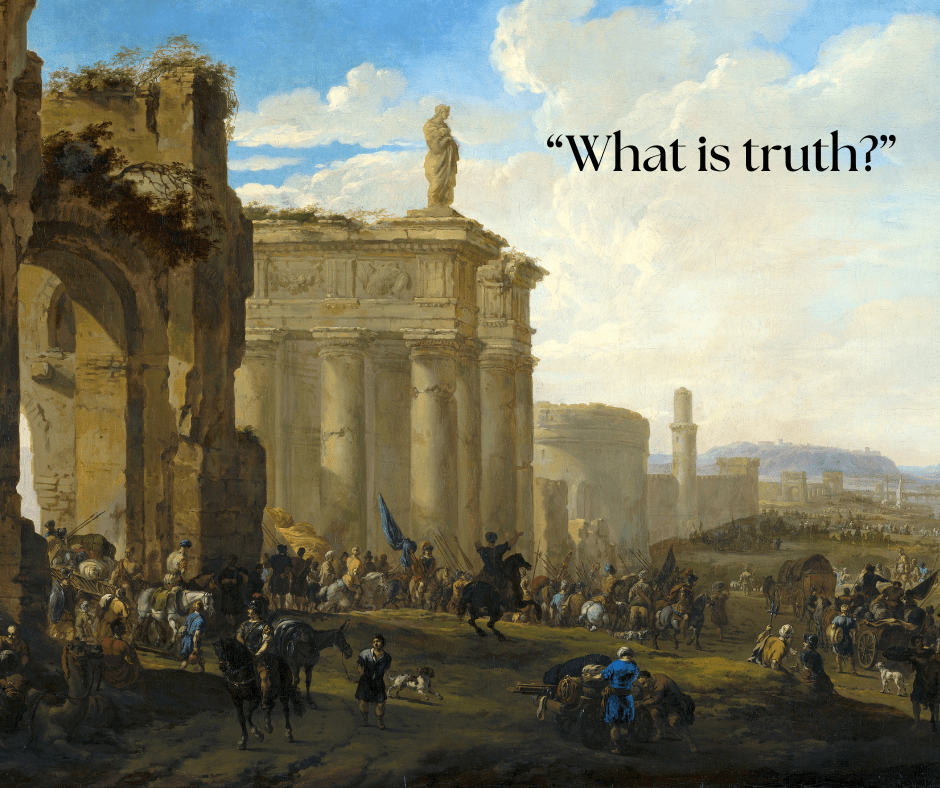

What Is Truth?


Our culture has trained us well to expect a general level of salesmanship, gimmick, and creative accounting in all areas of life. Whether the showroom, the courtroom, the campaign trail, or even the pulpit, we live in a world where far too often realities are stretched and assumptions are left uncorrected in order to gain advantage.

While we might not admit it aloud, we often think of basic honesty as naïve at best. “The world just doesn’t work that way anymore” we think, or we embrace some version of the logic that “honesty may be the best policy, but we aren’t dealing with good people” that allows us to justify our own departures from the truth.

The reality is that some things are true whether I want them to be or not. My opinion on whether or not the laws of gravity apply to me does not impact whether or not I will fall if I slip while on my roof. I may be thoroughly convinced that gravity is not real or that I never granted such an abstract force the right to control my life, but I will still find myself on the ground looking up. Strong commitment is great, but even the most solid commitment to the wrong idea just leaves me sore and corrected by experience.

Jesus and the Roman governor Pilate engage in a revealing conversation in John 18-19. Jesus, having been arrested and falsely accused, is brought before Pilate to receive punishment. It is festival season, and Jerusalem is teeming with hundreds of thousands of weary, foot-sore people already unhappy with Pilate’s rule. In addition to the crowds, the local religious leaders and the figurehead of Rome’s puppet government in the region also have an interest in what happens to Jesus.

Jesus shifts the emphasis from political expediency and Pilate’s desire to be let off the hook to the everlasting mission of God- that God’s Christ would come to proclaim the true reality of God and that all who receive this truth will be a part of God’s kingdom.

Ever the politician, Pilate remarks, “What is truth?”

We don’t know Pilate’s tone, but his subsequent actions indicate he was unwilling to see the Way, the Truth, and the Life standing directly in front of him. Jesus says even Pilate’s authority is not of his own making, and yet Pilate uses his agency to choose the “go along to get along” path rather than to stand for what is true and right. He declares the innocence of Jesus while in the same moment consenting to His death. Truth can be realized in thought, acknowledged in word, and yet still be ignored in action.

Each day, the world around us encourages us to choose what is easy and smooth over what is difficult and may prove dangerous. If we believe that truth is most fully known and experienced in Jesus, will we be willing to stand for what is right when it would be easier to ignore falsehoods and dodge hard conversations? Ultimately, there can be no peace with God and no lasting peace with others without the foundation of truth. May we seek to lay this strong foundation, and having done so, build our lives and character upon it.

How We Hold Together


You have likely seen such vehicles after a big community yard sale. Driven by a person who “was just going to look,” it is now filled with two tables, three mismatched chairs, some assorted shelves, multiple lamps, and several boxes of odds and ends. This bounty is held in the back of the small pickup with bungee straps, some well-worn packing twine, and no small measure of hope. As this heavy-laden truck passes, you think, “There is no way that will hold together.”

When we look at the church as described in the pages of the New Testament, any outsider, even one sympathetic to this new movement, would have taken one look at the odd assortment of people that made up that first Christ-centered community, and thought, “There is no way they will hold together.”

And yet they did- often remarkably well.

We could credit God’s favor on the early church, and Scripture testifies to that reality. It could be pointed out that beginning on the first Pentecost after the resurrection of Jesus the church was blessed with the powerful, miracle-bringing gifts of the Holy Spirit, or the fact that almost all of the original leaders had been personally discipled by Jesus Himself. While all of these factors combined to bless the church, I also believe those early disciples had to choose to stay focused and faithful to their message and this shared message of love, grace, and hope experienced in Christ Jesus not only anchored them in Him- it bound them to each other.

One trait we clearly recognize in the early church was their belief that both blessings and burdens were to be communal experiences. This connection was material and financial, but it was also expressed in deep emotional and spiritual commitments. These first Christians were concerned about the general welfare of the community of faith. In the survival-of-the-fittest world of the Roman empire, a world not all that different from our own, Christians were to be moved by each other’s joys and sufferings. Paul summarized this spirit in the quotable reminder to the congregation at Rome- “Rejoice with those who rejoice, and weep with those who weep” (Rom 12:15).

Not only was the early church emotionally united, they also sought (often imperfectly) to subdue all party spirit to the authority of Christ. Identifiers that shaped their worldviews and relationships outside of the church were to be overwhelmed by the higher calling of devotion to Christ. Paul wrote to the churches of Galatia to remind them that distinctions of ethnicity, gender, and cultural background, while not ceasing to exist outwardly, were to be submitted to the greater unity found in shared commitment to Christ. As long as differences were allowed to hold dominant sway over Christian hearts and behavior, the church struggled, but when such differences were acknowledged as present but placed under Christ’s authority, the church benefited and was blessed by differing perspectives. Ultimately, as a patchwork of different regions, races, and worldviews, the church was forced to confront the reality that, as “the greatest of these,” love must serve to align diverse gifts and perspectives (1 Cor 13).

Today, if we want to hold together and present a united witness to our world, we must love the truth of God’s Word and allow His Word to guide us in loving each other. We hold on to Jesus, and we strive to hold on to each another. This love for God and love for neighbor is the foundation not only of any lasting Christian unity but is also our best hope for a kinder, more grace-filled world.

Prayer for Stormy Times


Father God, the weather is unpredictable, but we know that You are constant and ever-sure.

Like the spring, we too are inconstant; often blown off course and shifting in the challenges and trials of life.

You know our frame, our limitations, our weaknesses. Despite our defenses, we falter, fail, and fall.

Help us to see that our effort at self-defense always leaves us short of the deliverance that can only be experienced in surrender to You. Give us the ability to see the folly of resisting our great need for Your divine care and grace in each moment of our lives.

Even we who long to reach upward can never scale to the perfect heights we seek. We give thanks that in lovingkindness You descend to us.

In the blessings of our daily experiences, in the bold assertions of Your word, in the beautiful community of the church- You show us more of what we can be.

Yet these gifts would be nothing without the Giver.

Incarnate in Bethlehem, walking in Galilee, dying outside Jerusalem, rising in power to die no more.

In Jesus, You come among us clothed in the dust and ashes of creation.

You do not offer an absentee love, but place the fullness of Yourself in our midst.

To the vulnerable, You are a protector.

To the self-sufficient, You are a servant.

To the prideful, You are a warning.

To the broken, You are a healer.

To the burdened, You are a liberator.

To the hungry and hopeless, You are Daily Bread and Living Water.

To the lost, You are the Way, the Truth, and the Life.

In Your grace, You choose to place Your love upon us. You extend constant sustaining blessings and the opportunity for salvation.

What more could You do to give Yourself to us and for us?

Help us to see this love. Help us to accept it. Help us to experience it more and more fully, and help us to live our lives in response to it. In this season, let us choose to pass forward the love we have received.

In tense times and uncertain days, may our lives be marked by a Christ-like humility that silences the mouths of critics and opens the hearts of cynics.

Let us not be bewitched by power nor lulled into passivity. Give us the courage to withstand the assaults of enemies and the compromises of friends. Grant us, as Your people, the ability to shine light into the darkness.

Let us not be tossed by the stormy winds that threaten from both within and without, but let us instead be fixed and anchored to a love that cannot be shaken and will not be moved.

In Christ’s holy name and through His power we pray, amen.

Words That Build Up


We build some structures in our lives understanding that they will be temporary. Children enthusiastically build snowmen in the winter and enjoy constructing sandcastles at the beach. We may be thoughtful in putting up a tent for the night or building a duck blind for a season, but we recognize that the nature of such shelters is fleeting. Because of the limited uses and short lifespan of such projects, we invest in them differently than a home, a church building, or a historic structure.

The words we speak are more permeant than we often admit. When it comes to building others up, we must realize that our words today have the potential to make a difference that will echo in eternity.

Believers should never be guilty of flippantly using cutting phrases, sharp criticisms, or demeaning language toward others. Genuine compliments and encouragement should be the mark of Christian conversation while bitterness, vulgarity, and profanity must be banished from our lips. Words have the power to hurt deeply, and their impact lingers long after the exchange is over. Harsh words can knock down the work of years in a moment, and we as believers are to be builders not bulldozers when it comes to our interactions with others.

The apostle Paul writes in Ephesians 4:29, “Let no corrupt word proceed out of your mouth, but what is good for necessary edification, that it may impart grace to the hearers.”

In speaking into the lives of others, we must look to remove corrupt communication from our lives. While this certainly includes overt profanity and lewd language, it also includes more subtle ways our speech can be used to erode the spirits of others. Gossip, boasting, half-truths, and mocking jokes made at others’ expense are just a sampling of ways our words can hurt.

As believers, we must appreciate that people are not punchlines and that even passing comments leave a lasting impact. Even after decades, we can remember how being teased as a child, mocked as a teenager, or chewed out by our first boss made us feel. We cannot control the words of others, but we can recognize that the words we release into the world are not simply a temporary venting of frustration but have the potential to impact lives far beyond the moment. Rather than being thoughtless or cruel, we should seek “necessary edification”- choosing to build up those around us with intentionally grace-filled speech.

In seeking to build others up, we should look for genuine strengths in the lives of those around us. We live in a social media, cable-news-saturated world that daily attempts to remind us of all the dangers and darkness swirling close by. When it comes to those we are interacting with face-to-face, we can cut through the noise and notice the blessings our family, friends, and neighbors bring into our lives. In conversation, we can choose to be thankful, positive, and kind thereby building a foundation of honoring God and imitating Christ in all our relationships.

We who experience life in Christ are blessed with His presence now and the confidence of joy in eternity, and yet sadly we can often be surly, standoffish, and suspicious. We dare not be known as cynical, critical, and crude in our interactions with others. While no one perfectly tames the tongue in this life (James 3), we cannot allow corrupting speech to become the default pattern of our conversations.

Our words matter, and we must use them as tools to build rather than weapons to wound as we live out our faith each day.

FRAGILE: Handle with care


Ann Marie recently received a set of lamps as a Christmas gift. After the holiday, I decided to unbox the lamps and set them up. The process was straightforward- remove the lamps from packaging, perform minimal assembly, put in the bulbs, plug into the outlet, and the light would shine.

Only when I began my project did I notice how heavily wrapped and tightly secured the lamps were inside layers of protective packing materials. All over the box was the warning: FRAGILE: HANDLE WITH CARE. Rather than forcibly breaking into the boxes, I followed the advice and carefully cut away the outer wrappings. The delicate vase-like base of each lamp was still intact, and due to the helpful warning, I was able to appreciate the need for extra care as I assembled the lamps.

When we handle precious, breakable, or valuable objects, we understand it is worth being careful to prevent loss and avoid unnecessary damage. What is a more valuable combination than the Word of God applied to a human soul?

In Christ, we have been blessed with “exceedingly great and precious promises” in Christ (2 Pet 1:4). Because these gifts come from God and are essential in carrying His message to the wider world, we must take care in how we use and handle these blessings. If we do not live out of a grounding in the reality of God’s promises, we quickly drift from His will for us. It is our living out of the Christian message, not our words in isolation, that ultimately influences others for Christ.

Sometimes when meeting a person for the first time, the topic of faith arises. Often, people noticeably shift and even bristle when belief and church life are shared as positives. Sadly, abuse cover-ups, financial corruption, moral scandals, and general mean-spiritedness are associated by many people with the label of Christian. While we might feel that such analysis is not fair, we would be foolish as believers not to acknowledge and admit the many well-known cases of those who have publicly presented Christ violating the trust and breaking the faith with large numbers of people. We know that on a smaller scale, local churches, families, and individuals at times have used the name of Christ as cover for great wrongs.

When it comes to handling the richness of the gospel, our words and actions must be considered with care. In the words of Jesus, we must be “wise as serpents and as harmless as doves” (Mt 10:16). As Paul wrote we must, “Let your speech always be with grace, seasoned with salt, that you may know how you ought to answer each one” (Col 4:6). We should seek to adopt the manner of Jesus who, while upsetting the corrupt and abusive religious practices of His day, also displayed a compassion for individual souls that allowed it to be poetically said that He would not break a fragile spirit or snuff out the smallest flame of faith (Mt 12:20). In sharing the message of Jesus, we must be able to convey that apart from Him we have no hope, yet speak in a way that does not despair but points to God’s grace.

This week, may we remember that the good news we hold is precious, and we must steward it faithfully. May we also realize that many people around us are fragile and have been broken by the hardships of life and have become disillusioned with faith. As we seek to offer God’s precious message to broken and bruised people, may we lean on the example of Jesus and speak the truth in a way that draws the hurting to Him.