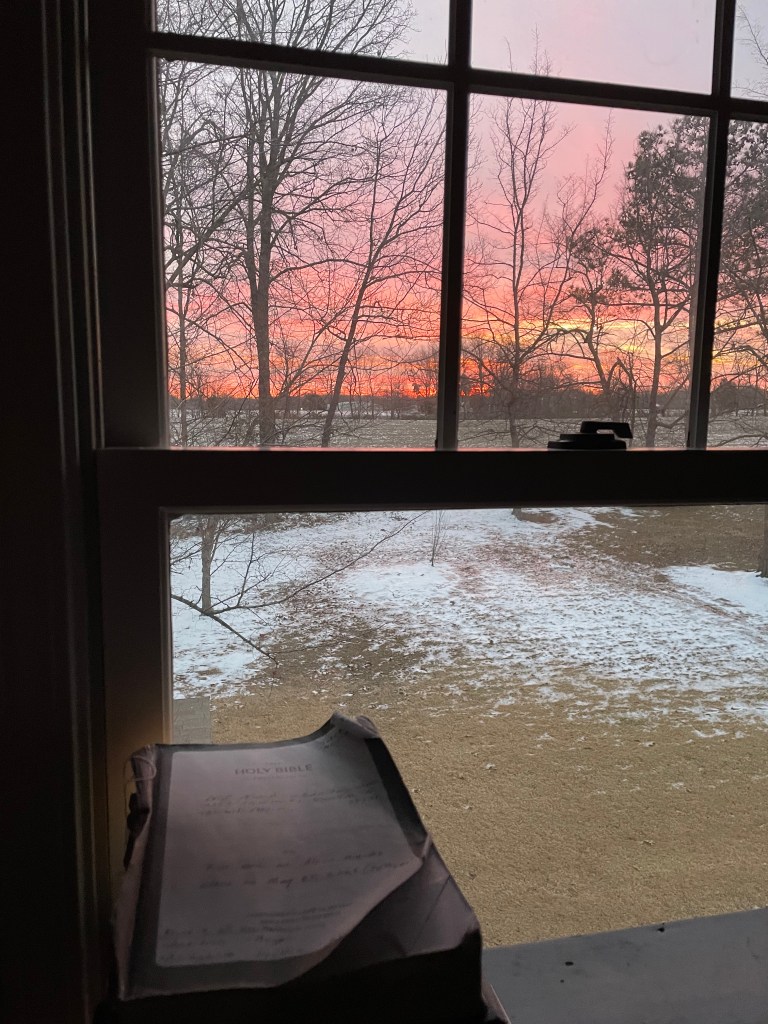
Lest we forget Gethsemane…

Sometimes a verse you have read a hundred times just hits differently. The Scriptures are timeless, but as believers, we are shaped and shattered by time and our own experiences, and we bring our changing perspectives to our reading of God’s Word.

Between Luke 22:42 when Jesus prays in the Garden of Gethsemane for relief if possible but for the Father’s will to be done above all, and Luke 22:44 which describes His agony and the intensity of His sorrow dripping down as blood-like sweat, Luke 22:43 reads:

When I read this recently, I was reminded of Hebrews 2:16, “For indeed He does not give aid to angels, but He does give aid to the seed of Abraham.”

Jesus did not take the form of angels to redeem them, and yet angels strengthened Him as He came in human likeness to redeem us. In His moment of greatest suffering, Jesus was blessed by strength sent from heaven and was empowered to endure. It has been said, “Every life has its Gethsemane, and every Gethsemane has its angel.” In that ancient grove, among the olive trees whose fruit was pressed to bring forth oil for food, light, and healing, Jesus was pressed down and poured out for us.

I know people right now passing through their own pressing dark night of the soul- illness, addiction, estrangement, grief, loss. You know these folks too- it may even be you or someone close to you is experiencing such a season even as you read these words. Whatever we face, may we realize that when Jesus suffered on our behalf, He was not instantly delivered nor was the source of His suffering destroyed- instead, His Father provided Him with the strength to bear the terrible burden.

Whenever we suffer, we are never alone. No matter what form our trials take, our Lord stands with us in the midst of the hurricane to strengthen and support us. Not only in the form of faithful friends, not only through the unseen ministries of angels, but God Himself is with us and within us to supply His power to help us endure.

“He who dwells in the secret place of the Most High shall abide under the shadow of the Almighty. I will say of the Lord, ‘He is my refuge and my fortress; My God, in Him I will trust.’” (Psalm 91:1-2)

May we continually draw strength from the realization that while darkness lingers, ultimate suffering has been already been overcome- not by our strength, but by Christ’s surrender and His suffering in our place.

In His humility, Jesus comes as one of us and takes life’s harm, hurt, and hate on our behalf. In our own strength, we can never simply resolve and then do better. We can never fully overcome the pull of our own hearts to forsake the best and right paths for those that seem simpler, safer, and easier. We cannot power through the struggles, sufferings, and sorrows of this life alone, but we can, when conformed to the spirit of Christ, humbly surrender and receive the strength and the support that God supplies.

In looking to the Father’s strength and trusting His will, we imitate the perfect example of Jesus, and we gain the assurance of God’s presence and power with us our trials.

Each life indeed has its share of Gethsemane’s sorrows, but because of Gethsemane’s Savior, we never need to bear our burdens alone.


In Praise of Small Places


“Can anything good come out of Nazareth?”

This question comes from the lips of Nathanael, a man whom Jesus Himself would commend for being a straight talker (John 1:46-47). Today Nazareth is a predominantly Muslim city of nearly 80,000 people in northern Israel. Modern Nazareth also has a large Christian population and the city benefits from tourism centered around the New Testament testimony of ancient Nazareth as the hometown of Jesus. If you are familiar with Scripture and remember the town’s name, you most likely think of Nazareth in the context of the oft-repeated designation of our Lord as “Jesus of Nazareth.”

Today, Nathanael’s incredulity at the origins of the Messiah seems out of place. After all, 80,000 people is well more than double the entire population of Weakley County, yet in its day, Nazareth was a tiny village- neither David’s birthplace (Bethlehem) or the home of God’s temple (Jerusalem). Nathanael raises an honest question, “How could someone so great and so important come from such a small, forgotten place?”

I admit I hold a great affection for small places. I have lived in four towns in my four decades of life- all in West Tennessee and each with less than 3,000 residents. While I have been blessed to travel to some of the largest cities in the world and enjoyed those visits, I have returned here again and again. I will be the first to confess small places are not perfect- in fact, they hold the same challenges as cities even if harder to recognize. Small towns can serve as strongholds of hypocrisy, islands of poverty, dens of crime, and homes to violence. Hard times hit small places hard- when factories close, when younger generations move away, when addictions arrive to fill the emptiness and loneliness of hurting people.

Despite the struggles, I believe there is value in the intimacy of such a life.

To know the names of the people you meet each day at the store and in the bank- to love them as your parents loved their parents as your grandparents loved their grandparents. To shop local because you know the family’s youngest daughter got braces last week or because their uncle passed suddenly and you want to help with expenses. For an old man to remind you of what a great athlete your daddy was or to thank you for your grandfather’s service in the war. To be told you come from good stock or to be praised for overcoming a tough upbringing. To hear the same stories again and again, and although you were born fifty years after the fact, you feel like you saw the drought, the winning shot, or the great fire. To see hardworking people slip a few bills into a young father’s hand when he was short at the store- careful not to let his children see that he had come to the end of his money but not to the end of the month. To know those church ladies armed with worn Bibles and well-used casserole dishes who always whispered to the young teachers each August, “If you have any children in your class who need anything, you just let me know.”

No place is perfect. Even in small places, we face challenges to fund and feed and fix, and we often disagree on how best to do that. We have many differences in how we think, worship, vote, and live, yet we should not be surprised that the Man who taught us to love God and to love our neighbor came from a place where He would have known His neighbors by name.

When we are committed to loving God and serving where He has planted us, good things will continue to come from the least likely places.

Fully Known & Fully Loved


“I’m fine.”

It’s likely we have received or offered this generic line many times when responding to the classic question, “How are you?” Many of us spend a great deal of time and energy seeking to be (or at least appear) self-sufficient in the eyes of those around us. The reason for this attitude differs- pride at our own ability to handle things, a genuine desire to not worry others, or even our unawareness of our own needs.

One of our greatest desires as human beings is to be able to share experiences and to relate to those around us. We have witnessed this when small children go off to school, when we travel abroad, or when seniors move into a new retirement community. In the midst of new and potentially overwhelming situations, we long to find a person with who we can relate to and share our discomfort. One true friend, a helpful local who speaks our language, or a friendly face to welcome us serve as blessings that give us the strength to keep going in tough moments.

On the other hand, one of our great fears lies in the idea that if people really knew us, they would not love us, care for us, or help us. This mindset can have long and lasting negative results. Such an attitude can cause us to avoid engaging with others to seem strong and competent. Sometimes the impact is relatively small like when we refuse to ask for help in a store or resist asking for directions in driving- we may be delayed and frustrated, but we are more inconvenienced than hurt. Other situations, like denying help for addiction or struggling alone with anxiety or depression, can have life-changing impact if we are not able to overcome fear and to receive the support we need.

To be human is to be made of dust and to be made of dust is to be vulnerable, and yet many of us spend a great deal of time and effort seeking to convince those around us we are fine just as we are and do not need help from anyone.

In our relationship with God, we do not have to fear being known. He already knows us fully, and He loves us completely. He appreciates all that we are and all that we try to be, and He also sees the darkness that many of us seek to avoid dealing with by pushing it deeper to the corners of our lives.

We constantly strive to build up our own defenses even as our loving Father offers not stronger defenses against our worst impulses but divinely-empowered deliverance from them.

One attribute God possesses that we do not is the ability to know the entirety of a situation. As people, we may downplay, mislead, or intentionally lie about when we are struggling and dealing with conflict and trials, but there is no hiding the needs of our hearts from God. He already knows, and He welcomes us, broken as we all are, to come to Him.

We all long to be more fully known and yet we fear that if we are completely honest, we will not be loved.

Thankfully, God’s love is not based on our perfection, but in His nature.

The great blessing comes when we cease to struggle against this love, and rather gratefully accept it and live our lives out of its reality. In Christ, we are called to not only accept His gracious love for us but to receive it gladly then to turn and extend it to others.

Accepting this loving reality of relationship forever alters our answer to the question, “How are you?”

“I am loved.”

Nothing Remains Hidden


In Mark 4:22, Jesus makes a startling declaration, “For there is nothing hidden which shall not be revealed, nor has anything been kept secret but that it should come to light.”

As we look at our own lives, does this revelation from the mouth of Jesus comfort or frighten us?

If you are like me, there is no shortage of situations in the world I do not understand. Despite this fact, I take comfort in knowing while I cannot always discern motives or circumstances, I am not given that responsibility. My role is not to judge or commentate or dismantle the mindsets of those around me; my God-given task is to love others and to serve in ways that both help them and honor God. It is important to realize that neither you or I are alone in this calling- for all the negative things that are often out front in our world, there are countless actions of faithfulness unknown to you and me, yet fully known to God.

The revelation of who we truly served is one aspect of final things that is going to surprise and shock many. In Matthew 25, Jesus tells His hearers in refusing to help others we have in reality refused to help Him, and in serving others, we have actually served Him. One aspect of this passage that is often overlooked is the fact that neither group, those who refuse nor those who help, knew that their attitudes and actions toward “the least of these” were their responses to Jesus Himself.

Jesus comes to us in the circumstances of our daily lives and in the people who cross our paths- in the sick, the broken, the lonely, the hurting, the fearful, the abandoned, the addicted. We are not commanded to accomplish great, impressive feats for others, but we are called to faithfully take action in the opportunities placed into our trust.

No good that we do is ever lost or ever wasted. Even when the external reactions we see appear mixed, small, or hostile, there is value in giving our lives in submission and service. The best part of spiritual work is the part that is known within our hearts and visible only to God. Better to do small actions with good motives than pridefully seek praise and recognition for the good that we do. There will many saints unknown to history who will be rewarded for graciously offering a cup of water in the name of Christ while others who have been praised for piety will be sent away empty.

If we can come to appreciate that no action is unseen by God or forgotten by Him, we can begin to cease striving for others’ constant approval. We can work without fanfare and without the need for acclaim knowing that what seems small and hidden now is fully seen by our good Father.

We usually think of hidden things being revealed in the sense of the classic expression, “your sins will find you out.” While it is true that judgment will reveal the darkness in us all, it will also reveal the many people who have served in quiet, humble, seemingly-forgotten ways and, sometimes without fully realizing it, were serving Jesus all along.

As a disciple, my awareness that God sees me and knows my deepest motivations should cause me to live in such a way that each person I meet can come to see the presence of Christ in all I say and do.

Words That Build Up


We build some structures in our lives understanding that they will be temporary. Children enthusiastically build snowmen in the winter and enjoy constructing sandcastles at the beach. We may be thoughtful in putting up a tent for the night or building a duck blind for a season, but we recognize that the nature of such shelters is fleeting. Because of the limited uses and short lifespan of such projects, we invest in them differently than a home, a church building, or a historic structure.

The words we speak are more permeant than we often admit. When it comes to building others up, we must realize that our words today have the potential to make a difference that will echo in eternity.

Believers should never be guilty of flippantly using cutting phrases, sharp criticisms, or demeaning language toward others. Genuine compliments and encouragement should be the mark of Christian conversation while bitterness, vulgarity, and profanity must be banished from our lips. Words have the power to hurt deeply, and their impact lingers long after the exchange is over. Harsh words can knock down the work of years in a moment, and we as believers are to be builders not bulldozers when it comes to our interactions with others.

The apostle Paul writes in Ephesians 4:29, “Let no corrupt word proceed out of your mouth, but what is good for necessary edification, that it may impart grace to the hearers.”

In speaking into the lives of others, we must look to remove corrupt communication from our lives. While this certainly includes overt profanity and lewd language, it also includes more subtle ways our speech can be used to erode the spirits of others. Gossip, boasting, half-truths, and mocking jokes made at others’ expense are just a sampling of ways our words can hurt.

As believers, we must appreciate that people are not punchlines and that even passing comments leave a lasting impact. Even after decades, we can remember how being teased as a child, mocked as a teenager, or chewed out by our first boss made us feel. We cannot control the words of others, but we can recognize that the words we release into the world are not simply a temporary venting of frustration but have the potential to impact lives far beyond the moment. Rather than being thoughtless or cruel, we should seek “necessary edification”- choosing to build up those around us with intentionally grace-filled speech.

In seeking to build others up, we should look for genuine strengths in the lives of those around us. We live in a social media, cable-news-saturated world that daily attempts to remind us of all the dangers and darkness swirling close by. When it comes to those we are interacting with face-to-face, we can cut through the noise and notice the blessings our family, friends, and neighbors bring into our lives. In conversation, we can choose to be thankful, positive, and kind thereby building a foundation of honoring God and imitating Christ in all our relationships.

We who experience life in Christ are blessed with His presence now and the confidence of joy in eternity, and yet sadly we can often be surly, standoffish, and suspicious. We dare not be known as cynical, critical, and crude in our interactions with others. While no one perfectly tames the tongue in this life (James 3), we cannot allow corrupting speech to become the default pattern of our conversations.

Our words matter, and we must use them as tools to build rather than weapons to wound as we live out our faith each day.

Near to the heart of God


In times of uncertainty and pain as well as seasons of joy and calm, our daily goal as believers should be to draw nearer to the heart of God. We do this though paying attention to our emotions, filling our minds with Scripture, serving others, and lifting up our hearts in prayer.

I offer this prayer this week, and I hope you will use/adapt its words to fit the particular challenges and celebrations you may be facing today.


Lord, we ask to receive and acknowledge the appointed blessings You offer us this day. Help us not to grasp and grab, but to open our hearts and our hands to gratefully accept all that You seek to provide.

Grant us the ability to see the good around us and to praise You for it.

Help us to see blessings even in the midst of life’s burdensome seasons. Give us the awareness to appreciate grace even when it comes disguised as hard work, disappointment, or loss.

We would ask for the ability to see and discern what is best and most aligned for Your will for our lives.

Lord, help us to see ourselves.

Allow us to be honest and open with both our gifts and with our shortcomings.

Help us to realize and repent when we embrace paths that do not lead us into closer communion with You. Strengthen us to turn from such dangerous distractions and self-focused aims.

Only in appreciating our own weakness can we truly recognize our need to walk in continuous relationship with You.

We ask that our hearts would continually be open to Your nearness, and in this awareness, may we seek to share our hope with others.

We pray for the people we encounter each day- whether family in our homes or strangers on the street.

For those who do not know You, we pray for open eyes, open hearts, and opportunities to be impacted through the goods news found in Christ.

If we are knowingly living in rebellion to Your will, please draw us to Yourself through the message of the Word, faithful friends, and the conviction of conscience.

Give us the ability to live by faith- not rooted in our own self-will, but in every way aligned more and more to Your will for us.

Help us to praise the good works going on around us regardless of who will receive the credit. Allow us to be people who look to encourage rather than those who constantly seek to find fault. Help us to stay caring and curious as we navigate our way through this life.

Do not let us grow weary in doing good, but rather help us to develop the rhythms and practices we need to remain healthy even as we seek to serve the struggling. Give us an openness and awareness of people’s needs as we walk through life. Help us to observe and to inquire for ways to help and let us do this for people’s good and Your glory.

As we draw near to You, help us to see that such a focus allows us to draw near to others. Help us, like Jesus, to offer welcome and hope to the world that arises out of an assurance and connection to You.

In Christ’s name, amen.

Snow Day Stillness


Earlier this month, all of Weakley County lay under a generous blanket of snow. At one point, every county in Tennessee closed schools as the Volunteer State was inundated with winter weather from Memphis to Mountain City. While students received an extended break, workers braved the weather to keep power on, animals fed, and roads as clear as possible. The snow seemed to cast an almost eerie quiet over our community.

While the work of some increases in icy conditions, many of us find ourselves asked to stay home and off the roads in such weather. We live in a culture that loves to be on the go, and so we can find it challenging when forced to slow down. In the 1950s, researchers theorized that technological advances over the next few decades would make future America a land of increased ease and recreation, vastly reduced work hours, and longer, unstressed lifespans. While technology has certainly impacted and improved our lives in many ways, I don’t think we can honestly say it has helped us to slow down or lead far less hurried lives. In fact, many of us have allowed our increased options in travel, technology, and entertainment to turn us into people who cannot seem to enjoy the restful time we do have.

At least for a few days, the snow stopped or at least slowed down our pace.

Did you enjoy this change?

If social media is any indication, folks cooked, baked, read, worked puzzles, and watch movies. Despite the bitter cold, some people hunted or enjoyed playing outside with children and grandchildren. Some of us found ourselves with a little more time to check in on neighbors, to call up old friends, or to send those cards we had been intending to mail.

The Bible speaks repeatedly of the importance of stillness. Psalm 46:10 which opens with “Be still, and know that I am God,” holds within it the idea of ceasing our striving and realizing God’s ultimate control and assured victory. The gospels record Jesus commanding a physical storm to still resulting in “a great calm” (Mt 8:26; Mk 4:39; Lk 8:24). Whether our hearts are quieted by the assurance of God’s role in the world or we bear witness to His power to calm the upheaval in our lives, countless believers through the ages have experienced the truth of these passages.

Peace comes not through the absence of conflict but through the reality of God’s powerful presence.

Too often in the busyness of daily life, we forget that God is near to us. Because we do not stop in stillness, we lose touch with the knowledge of God’s true character. We find ourselves seeking more and more, and we neglect to pay attention to either our own souls or the needs of others (Lk 12:13-21). When we fail to withdraw to stillness, the pressures of family, work, community, and even church life grow heavier upon us. If we will not choose stillness, the grind of the always urgent press of our days will drain away the reserves of spiritual strength we can refill only in His presence (Mk 1:35-39). When this happens, we do not hear from God- we don’t have the time, and we are instead at the mercy of those who always seem to need or want our attention.

I pray stillness will not scare us, but that we can all aspire to be more intentional about seeking quiet moments with God. If we are willing to turn down the outside distractions, we become more attuned to what God longs to share with us in His presence- no snow required.

FRAGILE: Handle with care


Ann Marie recently received a set of lamps as a Christmas gift. After the holiday, I decided to unbox the lamps and set them up. The process was straightforward- remove the lamps from packaging, perform minimal assembly, put in the bulbs, plug into the outlet, and the light would shine.

Only when I began my project did I notice how heavily wrapped and tightly secured the lamps were inside layers of protective packing materials. All over the box was the warning: FRAGILE: HANDLE WITH CARE. Rather than forcibly breaking into the boxes, I followed the advice and carefully cut away the outer wrappings. The delicate vase-like base of each lamp was still intact, and due to the helpful warning, I was able to appreciate the need for extra care as I assembled the lamps.

When we handle precious, breakable, or valuable objects, we understand it is worth being careful to prevent loss and avoid unnecessary damage. What is a more valuable combination than the Word of God applied to a human soul?

In Christ, we have been blessed with “exceedingly great and precious promises” in Christ (2 Pet 1:4). Because these gifts come from God and are essential in carrying His message to the wider world, we must take care in how we use and handle these blessings. If we do not live out of a grounding in the reality of God’s promises, we quickly drift from His will for us. It is our living out of the Christian message, not our words in isolation, that ultimately influences others for Christ.

Sometimes when meeting a person for the first time, the topic of faith arises. Often, people noticeably shift and even bristle when belief and church life are shared as positives. Sadly, abuse cover-ups, financial corruption, moral scandals, and general mean-spiritedness are associated by many people with the label of Christian. While we might feel that such analysis is not fair, we would be foolish as believers not to acknowledge and admit the many well-known cases of those who have publicly presented Christ violating the trust and breaking the faith with large numbers of people. We know that on a smaller scale, local churches, families, and individuals at times have used the name of Christ as cover for great wrongs.

When it comes to handling the richness of the gospel, our words and actions must be considered with care. In the words of Jesus, we must be “wise as serpents and as harmless as doves” (Mt 10:16). As Paul wrote we must, “Let your speech always be with grace, seasoned with salt, that you may know how you ought to answer each one” (Col 4:6). We should seek to adopt the manner of Jesus who, while upsetting the corrupt and abusive religious practices of His day, also displayed a compassion for individual souls that allowed it to be poetically said that He would not break a fragile spirit or snuff out the smallest flame of faith (Mt 12:20). In sharing the message of Jesus, we must be able to convey that apart from Him we have no hope, yet speak in a way that does not despair but points to God’s grace.

This week, may we remember that the good news we hold is precious, and we must steward it faithfully. May we also realize that many people around us are fragile and have been broken by the hardships of life and have become disillusioned with faith. As we seek to offer God’s precious message to broken and bruised people, may we lean on the example of Jesus and speak the truth in a way that draws the hurting to Him.

Can You Be More Specific?


With the arrival of the new year, many of us are seeking to form new habits or renew practices to strengthen our walk with Christ. For the believer, prayer forms an important aspect not only of communication but deeper communion with God. Despite our acknowledging the essential nature of prayer, we often struggle to pray consistently.

What reminders can we apply in prayer to reengage when our prayer life has drifted to the dry or stagnant?

When we cannot seem to move beyond the laundry list of needs we often bring to God, it is powerful to stop and rejoice over the many blessings we already experience. Far too often, we give thanks in generalities. While we are indeed grateful for “all our many blessings,” we would grow in gratitude if we approached God at times with no other motive in prayer other than to say “thank you” for the blessings we now have. Rather giving thanks in summary before quickly moving to our remaining needs, I believe it would humble us to count, as the old hymn says, our many blessings, name them one by one, and see what God has done.

In addition to specific thanks, specific requests are vital as we enter God’s presence in prayer. While we certainly appreciate the reality that God knows our needs, the intimacy and comfort found in coming to God is increased when we are not content to pray in the abstract. While we understand the need to for broader, shotgun-like prayers in public settings (“We pray for all those grieving this week.”), our personal, private prayers can be filled with rifle-focused requests (“Lord, I lift up Mary from my high school class who lost her husband of 52 years last week after a long period of poor health. Strengthen her in her grief and in this new reality she is facing.”)

Not only does this specificity connect us more deeply to the people we pray for, but in praying this way, we come to see opportunities to add direct action to our prayers. Remembering people in more specific prayer naturally brings their needs to mind and may lead us to send a card, make a call, pay a visit, or perform a kindness.

Abstraction creates distance. If we pray for “the poor in our community,” we can keep struggling folks at arms-length. If I sit down and begin praying for Mrs. Smith who I know lost her son and is dealing with unexpected funeral expenses, I am much more likely to reach out to help. Both government and large-scale charity organizations are useful for the sizeable problems in our world, but the followers of Jesus must not turn away from praying for and seeking to serve our neighbors.

If we keep people in impersonal categories (the poor, the hypocrites, the liberals, the foreigners, etc.), it makes us much less likely to genuinely pray for or sincerely seek to serve them. The tendency to judge and generalize others is ancient, and it proves to be a damaging and destructive mindset for the people of God in every generation. Intentional prayer that leads us to serve breaks down these barriers and helps us imitate Christ in caring for individual souls rather than faceless crowds.

If we want to give ourselves to prayer in 2024, we make a good start by being more specific- both in the blessings we celebrate and the requests we offer to God.

God knows our hearts, but putting our thoughts into specifics helps us to know ourselves and those we would bless more fully.

All I Want for Christmas


Christmas is almost here, and many children are sharing in the holiday rituals of class parties, baking cookies, and sending letters off to Santa Claus. While we expect our children and teenagers to look forward to the exciting gifts that fill this season, what if we adults came to remember and appreciate the anticipation of Christmas?

If you could have whatever you wanted this Christmas, what would you ask for?

Peace on earth. While it has almost become a cliché, one of the hopes that has marked the Christmas season for generations is the longing for peace. Whether wars and conflicts around the world or the strains and stresses of the relationships in our own homes, we recognize that not all is as it should be in this life. Near and far, people of good will long for peace- peace that comes when we lay down not only the weapons of violence but the fear, anger, pride, and greed that drive conflicts great and small.

In this longing, we reflect the same hopes of our spiritual ancestors. The coming Messiah was foreseen as the Prince of Peace, and Jesus’ arrival was as heralded as the coming of the Christ, the Savior, and the Lord, yet the ministry of Jesus was met with resistance, ridicule, and violence. As followers of Jesus, we commit to constantly seeking the path of peace even in a world that often confuses brute strength with true power.

Presence of those we miss. In a time so often centered on community and kin, many long to be united with loved ones once again. We each have those we care for whose absence is especially hard during this season of togetherness. There are different reasons for our divisions- physical distance keeps many of us apart while discord keeps some from being able to simply drive across town and say, “Hello.” Depression often isolates, disease can drain us, and divorce can lead to withdrawal and bitterness.

Ultimately, death deprives us of each other’s physical presence, and as the years pass, we come to recognize this more and more. We each reach a certain point where more people we love are absent than present. How we long for reunion when all things are made whole and painful absence is replaced with constant presence! We take comfort that such sorrow is known to God, and that He too longs for His children to be reconciled and present with Him.

Possibilities of better things to come. Not all of our longings are based in what we lack. The arrival of Christmas also marks the passing of one season and the coming of a new year. As believers, we are not to be only mourners of what is lost, but to live as celebrants of the new life to come. We believe that the best is yet to come, and that God is even now working things together for the good of His people and the glory of His name. We lean toward the fullness of this better, living way that is already present but not yet fully realized in us. We desire that the kingdom of light Christ entered our world to bring and sacrificed His life to birth be brought more and more fully into our world and our own lives in the coming year.

As a fellow grown-up, I urge us not to leave Christmas longings to the kids and grandkids. May we claim a share of this season’s spirit of anticipation for ourselves, and allow our thoughts, words, and actions to be shaped by the reality of Christ’s presence among us.