Our culture has trained us well to expect a general level of salesmanship, gimmick, and creative accounting in all areas of life. Whether the showroom, the courtroom, the campaign trail, or even the pulpit, we live in a world where far too often realities are stretched and assumptions are left uncorrected in order to gain advantage.
While we might not admit it aloud, we often think of basic honesty as naïve at best. “The world just doesn’t work that way anymore” we think, or we embrace some version of the logic that “honesty may be the best policy, but we aren’t dealing with good people” that allows us to justify our own departures from the truth.
The reality is that some things are true whether I want them to be or not. My opinion on whether or not the laws of gravity apply to me does not impact whether or not I will fall if I slip while on my roof. I may be thoroughly convinced that gravity is not real or that I never granted such an abstract force the right to control my life, but I will still find myself on the ground looking up. Strong commitment is great, but even the most solid commitment to the wrong idea just leaves me sore and corrected by experience.
Jesus and the Roman governor Pilate engage in a revealing conversation in John 18-19. Jesus, having been arrested and falsely accused, is brought before Pilate to receive punishment. It is festival season, and Jerusalem is teeming with hundreds of thousands of weary, foot-sore people already unhappy with Pilate’s rule. In addition to the crowds, the local religious leaders and the figurehead of Rome’s puppet government in the region also have an interest in what happens to Jesus.
Jesus is accused of setting Himself up to be a king- a claim, that if true, would put Him in rebellion against Pilate’s government. Pilate questions Jesus about His plans, and Jesus responds that His kingdom is not from this world. While showing no interest in setting up a new earthly dynasty, Jesus tells Pilate he is not entirely wrong, “You say rightly that I am a king. For this cause I was born, and for this cause I have come into the world, that I should bear witness to the truth. Everyone who is of the truth hears My voice.” (John 18:37 NKJV)
Jesus shifts the emphasis from political expediency and Pilate’s desire to be let off the hook to the everlasting mission of God- that God’s Christ would come to proclaim the true reality of God and that all who receive this truth will be a part of God’s kingdom.
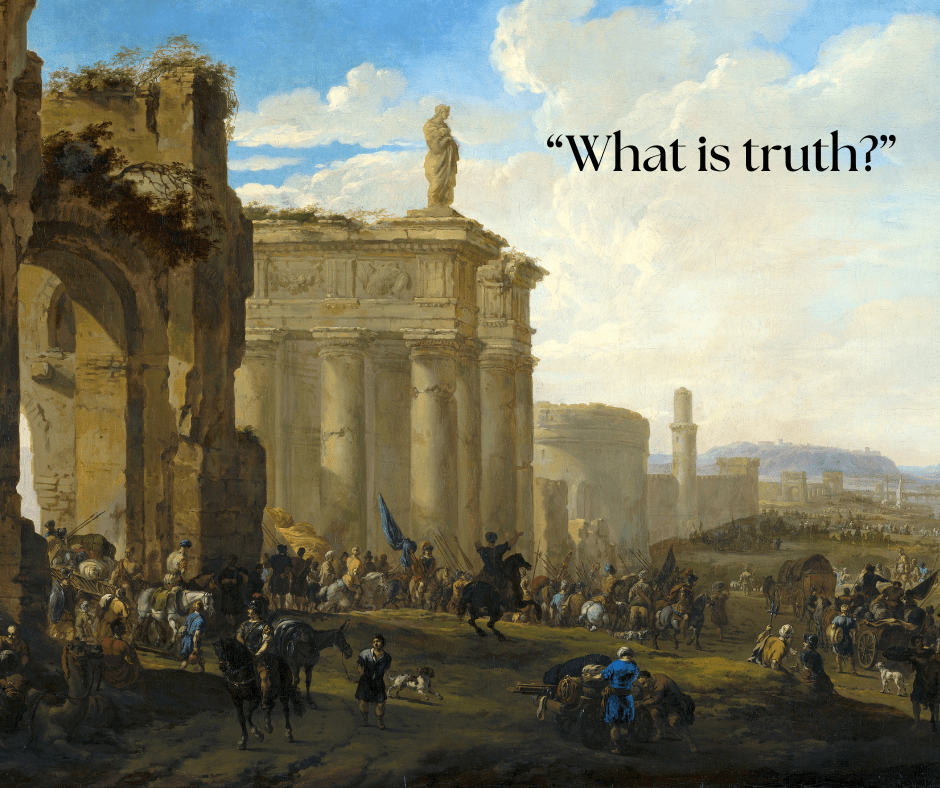
Ever the politician, Pilate remarks, “What is truth?”
We don’t know Pilate’s tone, but his subsequent actions indicate he was unwilling to see the Way, the Truth, and the Life standing directly in front of him. Jesus says even Pilate’s authority is not of his own making, and yet Pilate uses his agency to choose the “go along to get along” path rather than to stand for what is true and right. He declares the innocence of Jesus while in the same moment consenting to His death. Truth can be realized in thought, acknowledged in word, and yet still be ignored in action.
Each day, the world around us encourages us to choose what is easy and smooth over what is difficult and may prove dangerous. If we believe that truth is most fully known and experienced in Jesus, will we be willing to stand for what is right when it would be easier to ignore falsehoods and dodge hard conversations? Ultimately, there can be no peace with God and no lasting peace with others without the foundation of truth. May we seek to lay this strong foundation, and having done so, build our lives and character upon it.
 will norrid writes